


What Is Design Thinking? Definition, Process, 5 Stages & Why It Is Important


Short Description
Design thinking is one of the most talked about terms in business and innovation today, but few people can explain it clearly. This guide breaks down its definition, the five-stage process, its core principles, and why organizations from startups to global brands use it to solve real problems.
Blog Summary
Design thinking is a human-centered approach to solving problems. It starts with real people and their needs, not with a product idea or a business goal, and it has become one of the most widely used innovation frameworks in the world.
This blog explains what design thinking means in simple terms, walks through its five stages and five core principles, and shows how companies like Apple, Airbnb, and Uber have used it to build products people actually want. It also covers where the method commonly goes wrong and how businesses, students, and professionals can put it into practice.
Introduction
Design thinking has become one of the most used terms in business, education, and product design, but the meaning behind it often gets lost. At its core, design thinking is a practical method for solving problems by focusing on the people affected by them first, before jumping to a solution. This is what separates it from most traditional problem-solving approaches, which tend to start with a product idea or a business target instead.
This guide explains what design thinking is, how the process works, and why so many organizations rely on it. It also shows how the method connects to Design Thinking For Innovation as a practical, repeatable discipline, and how it fits into a broader digital transformation consultancy approach used by many modern businesses and business innovation framework today.
Design Thinking Definition
Before going further, it helps to define design thinking clearly, since the term gets used loosely across marketing, business, and education.
What Is Design Thinking In Simple Words?
In simple words, design thinking is a way of solving problems that starts with the people who have them. Instead of asking what a business wants to build, it asks what a person actually needs, and works backward from there. IDEO, the design firm most credited with shaping the modern practice, has used this approach since 1978 to build products that fit real behavior rather than assumptions [1]. The process is repeatable, which is what makes it useful beyond a single project or team.
The Core Idea Behind Design Thinking
The philosophy behind design thinking is called human centered design. The International Organization for Standardization defines it as an approach that focuses on the needs, behavior, and context of the people a solution is built for [4]. Design thinking applies that same philosophy to any kind of problem, not just product design, which is why it has spread far beyond design teams.
Origins Of Design Thinking And Its Evolution
The phrase design thinking is credited to David Kelley and Tim Brown of IDEO and Roger Martin from the 1990s although the concept dates back to 1969 in the book The Sciences of the Artificial by Herbert Simon [4][5]. Tim Brown's 2008 Harvard Business Review article later helped bring the method into mainstream business use [2].
Why Is Design Thinking Important?
Design thinking earns its place in business strategy for a simple reason. It consistently produces solutions people actually use, not just solutions that looked good in a planning meeting.
Solving Complex Problems With Human-Centered Thinking
Complex problems rarely have one obvious cause, and jumping straight to a fix usually treats a symptom rather than the real issue. Design thinking slows that process down. It starts by understanding what a person actually needs before deciding what to build, which is why it works well for problems that are messy, unclear, or involve many stakeholders [1][4].
Improving Innovation In Products And Services
Design thinking pushes teams past small, incremental changes and toward ideas that genuinely improve a product or service. Because ideas get tested with real users early, teams find out quickly whether something works, instead of spending months on a direction that never had real demand behind it. This is a large part of what makes design thinking a practical product innovation process rather than just a creative exercise.
Creating Better Customer Experiences
When a product or service is built around real user behavior, it tends to feel simpler and more intuitive to use. Fewer confusing steps and fewer unmet needs translate directly into higher customer satisfaction, which is one reason design thinking gets used so heavily in customer experience work.
Why Modern Businesses Use Design Thinking
Startups use design thinking to validate an idea before spending limited funding on the wrong one. Larger technology companies and enterprises use it to keep large product teams aligned around real user needs instead of internal opinion. Both get the same underlying benefit which is fewer expensive mistakes.
The Design Thinking Process: The 5 Stages Explained
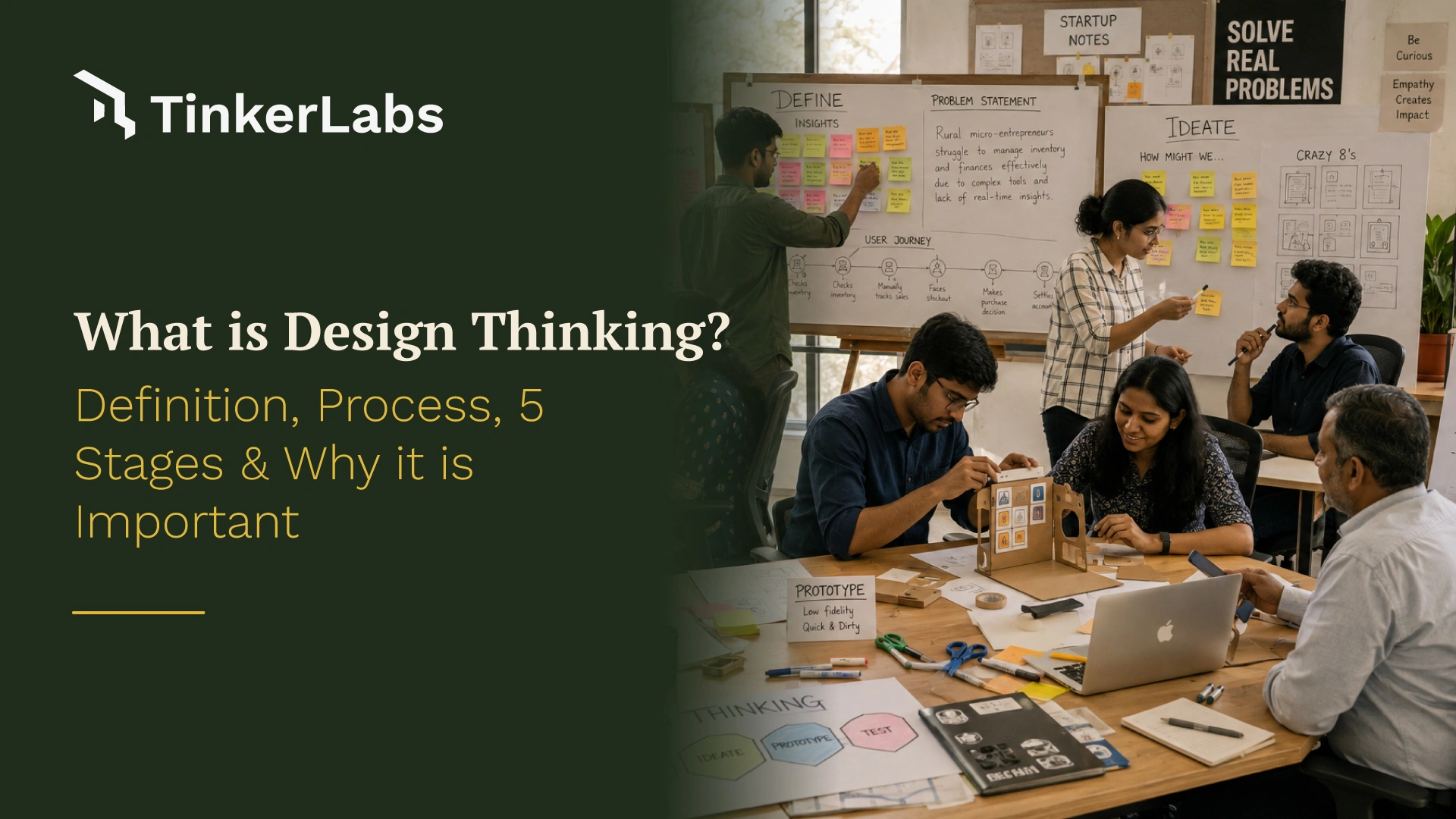
Several versions of the design thinking process exist, but the five-stage model developed at Stanford's Hasso Plattner Institute of Design, known as the d.school, remains the most widely taught [4][5]. The five stages of design thinking methodology are Empathize, Define, Ideate, Prototype, and Test. They are not meant to run in a strict straight line. Teams often move back and forth between them as new information comes in [4].
Stage 1 – Empathize: Understanding The User
This stage focuses on getting to know the user personally rather than making assumptions regarding his needs. This requires conducting interviews, observation and in some cases living in the user’s habitat in order to identify the problem personally [1][4]. The objective is to put one’s assumptions away and gather factual data.
Stage 2 – Define: Identifying The Core Problem
Research from the empathize stage gets turned into one clear problem statement, written from the user's perspective. A strong statement names a specific person and a specific need, rather than a vague business goal. This step gives the rest of the process a clear target to design against [4].
Stage 3 – Ideate: Generating Creative Ideas
With the problem defined, the team generates as many possible solutions as it can before judging any of them. The goal at this stage is quantity, not immediate quality, since a wide range of rough ideas is more likely to include a genuinely useful one [4].
Stage 4 – Prototype: Building Possible Solutions
The strongest ideas get turned into simple, low-cost models, a sketch, a basic mockup, or a rough working version. Prototypes do not need to look finished. Their only job is to make an idea real enough to react to and test [1][4].
Stage 5 – Test: Improving Through Feedback
Prototypes go in front of real users, and their feedback often reveals something the team missed. Testing frequently sends a project back to an earlier stage, and that is expected. The process is designed to loop, not to end after one pass [4].
What Are The 5 Principles Of Design Thinking?
Behind the five stages of design thinking framework sit a smaller set of principles that guide how the process actually gets used day to day.
Human-Centered Approach
Every decision in design thinking starts with the user's real needs and behavior, not internal assumptions about what they want. This principle is what the term human centered design refers to, and it underpins every other principle on this list [4].
Collaboration Across Teams
Design thinking principles works best when people from different backgrounds, design, engineering, marketing, and operations, work on a problem together. Diverse perspectives tend to surface ideas that a single department working alone would likely miss [1].
Iterative Experimentation
Nothing in design thinking is meant to be finished on the first attempt. Ideas get tested, adjusted, and tested again, often several times, before a team commits to a final direction. This is what keeps risk low throughout the process.
Creativity And Idea Generation
The ideation stage works best when judgment is temporarily set aside. Encouraging unusual or even impractical ideas early on tends to lead to stronger, more original solutions once the group starts narrowing down options [1].
Learning Through Testing And Feedback
Feedback from real users is treated as information, not as a verdict on whether an idea was good or bad. Even a prototype that fails a test provides useful direction, since it usually reveals a specific reason it did not work, which is more useful than a vague guess.
What Is A Concept In Design Thinking?
Design thinking concept is the link between a raw idea and a prototype. It is more elaborate than a single-line idea generated through brainstorming, but it is still fluid enough for modification.
Understanding The Role Of Concepts In Problem Solving
With a concept, the team has something tangible to talk about and assess, rather than an intangible idea that they have floating around. A concept consists of a brief description of the functions of the solution, for whom it will be made and how it works, without going into the technical detail.
Concept Development During The Ideation Stage
During ideation, teams generate many rough ideas, then group similar ones and look for patterns. The strongest few get shaped into fuller concepts. This is where the quantity from the ideation stage starts narrowing into a smaller set of directions worth prototyping.
How Concepts Turn Into Prototypes
Once the team develops something that can be used by people, a concept transforms into a prototype. An idea for developing a scheduling application can take the form of drawing the booking page on paper, or an online mock-up which does not perform any functions. The goal at this point is to test the concept's logic, not to build the finished product early.
Real-World Examples Of Design Thinking
Design thinking is easier to understand through outcomes than through definitions. A few well-documented examples show how differently the process can play out depending on the problem.
Airbnb – Improving The Travel Experience
Airbnb nearly failed in its first year, with weekly revenue stuck under $200. The founders found the real issue by talking directly to hosts and guests and found out that low-quality listing photos were quietly killing trust before a booking ever happened. Instead of building a new feature, they flew to New York, borrowed a camera, and reshot listings by hand. Revenue doubled almost immediately, a direct result of understanding the user's actual problem rather than guessing at it [4].
Apple – Designing User-Friendly Products
Apple's product decisions have long started with how people naturally want to interact with a device, rather than a technical spec sheet. This approach is widely credited with helping the company reshape entire categories instead of simply competing within them. The iPod is a common example. It entered a crowded MP3 player market and redefined it by focusing on simplicity over feature count [4].
Uber – Rethinking Urban Transportation
Uber's original insight came from a basic observation such as hailing a cab in most cities was slow, unpredictable, and often frustrating to pay for. By focusing on the rider's actual experience, waiting, tracking, and paying, rather than the existing taxi industry structure, the company built a simpler process centered on a phone screen. This is the same pattern behind most breakout products credited to design thinking which is a specific, well-observed problem, solved from the user's side first.
Design Thinking Project Ideas For Students
Reading about design thinking is useful, but the fastest way to actually learn it is by applying it to a real project. Students in particular benefit from working through the five stages on a problem they understand firsthand, a campus service, a classroom tool, or a community issue, rather than a hypothetical business case.
For a full list of practical starting points, see 12 Design Thinking Project Ideas for Students & Engineering Innovators, which walks through student-friendly projects across sustainability, health, and campus life, along with guidance on running each one through the empathize-to-test cycle.
Innovation Projects Inspired By Design Thinking
Design thinking is not only for students or classroom exercises. Professionals looking to build a portfolio project, pitch an idea internally, or explore a career shift can apply the same method to real-world problems in healthcare, fintech, sustainability, and beyond.
A broader set of examples aimed at working professionals is covered in 14 Design Thinking and Innovation Project Ideas to Build Real-World Solutions, which lists project ideas built around specific users and problems that can be started with limited time and budget.
Benefits Of Design Thinking For Businesses
Beyond individual projects, design thinking changes how a business operates once it becomes a regular habit rather than an occasional workshop.
Encourages Creative Problem Solving
Teams that practice design thinking regularly get better at generating multiple solutions to a problem instead of settling on the first reasonable idea. This habit of creative problem solving tends to carry over into other parts of the business, not just formal innovation projects.
Improves Customer-Centric Innovation
Because every stage of the process starts with real user research, products built this way tend to align more closely with what customers actually want. This narrows the gap between what a business assumes customers need and what they actually value.
Reduces Product Development Risks
Testing ideas early and cheaply, before serious money gets spent, catches weak ideas long before a costly launch. This is one of the more measurable benefits of the process which is fewer expensive failures, because problems get identified while they are still easy to fix.
Strengthens Team Collaboration
Design thinking naturally pulls people from different departments into the same process, working from the same research and toward the same problem statement. This tends to reduce the kind of siloed thinking that slows down product development in larger organizations.
Common Challenges In Implementing Design Thinking
Design thinking sounds straightforward on paper, but organizations run into a few recurring problems when they try to put it into practice.
Misunderstanding The Design Thinking Process
There is a tendency among some teams to consider design thinking as just one workshop as opposed to a process. This involves moving on directly to ideas generation and prototyping without doing the necessary research and testing; hence the results are not very user-focused.
Lack Of Proper User Research
Weak or rushed research at the empathize stage tends to produce weak solutions later, even if every other stage is executed well. Teams sometimes substitute internal opinions for real user conversations, which quietly undermines the entire process from the start.
Organizational Resistance To Innovation
Some companies have cultures that reward certainty and discourage visible failure, which makes design thinking's emphasis on early, rough prototypes uncomfortable. Without leadership support for that kind of experimentation, teams often revert to safer, more familiar ways of working.
How Design Thinking Drives Innovation In Modern Businesses
Role Of Design Thinking In Business Transformation
Markets shift faster than most internal planning cycles can keep up with, which is why more businesses are building design thinking into how they respond to change, not just how they launch new products. Teams that regularly return to real user research are better positioned to notice a shift in customer expectations early, rather than reacting after competitors have already moved.
Combining Design Thinking With Digital Strategy
Digital transformation projects fail more often when they start from a technology decision rather than a user problem. Pairing design thinking with digital strategy fixes that order because now you understand what the user needs first, then decide which technology actually serves that need. This is the same sequencing a digital transformation consultancy typically brings to a large-scale change, treating the human problem as the starting point rather than the software.
Conclusion: Why Design Thinking Matters In Today's Innovation Economy
Design thinking earns its reputation because it solves a real, common problem which is businesses spend time and money building things nobody actually wants. Understanding the user first, defining the real problem, and testing ideas early is a simple sequence, but few organizations follow it consistently.
Whether the goal is a classroom project, a professional portfolio piece, or a full Design Thinking For Innovation strategy inside a company, the same five design thinking stages apply. That is what makes design thinking one of the most durable and widely applicable innovation strategy tools available today, regardless of industry or team size.
About the Author

Mandeep Toor
Head of Trainings & Workshops at TinkerLabs
Mandeep helps organisations build innovation capability through design thinking and behavioural science. With over a decade in innovation and entrepreneurship, he has led 75+ workshops for leaders at firms like Piramal Group, Samsung, Flipkart, HP, and Hindustan Unilever, and teaches Design Thinking at IIMs, MICA, and SOIL Institute of Management. Know more →
References
1. IDEO U. What is Design Thinking & Why Is It Beneficial?. [Internet] (Accessed Jul 2026) Available from: https://www.ideou.com/blogs/inspiration/what-is-design-thinking.
2. Harvard Business School Online. What Is Design Thinking & Why Is It Important?. [Internet] (Accessed Jul 2026) Available from: https://online.hbs.edu/blog/post/what-is-design-thinking.
3. IDEO U. The 7 Steps of the Design Thinking Process. [Internet] (Accessed Jul 2026) Available from: https://www.ideou.com/blogs/inspiration/design-thinking-process.
4. Interaction Design Foundation. What is Design Thinking?. [Internet] (Accessed Jul 2026) Available from: https://ixdf.org/literature/topics/design-thinking.
5. Nielsen Norman Group. Design Thinking 101. [Internet] (Accessed Jul 2026) Available from: https://www.nngroup.com/articles/design-thinking/.
Disclaimer
This article is intended for general educational and informational purposes only and does not constitute professional, business, or consulting advice. Statistics, historical details, and examples are drawn from third-party sources current as of publication and may change over time; readers should verify current information with the original source before relying on it for business decisions. Results from applying design thinking will vary by organization, project, and execution, and no specific outcome is guaranteed. Brand and company names referenced are used for illustrative purposes only and do not imply endorsement or partnership.

