


How to Run a Design Thinking Workshop That Produces Decisions


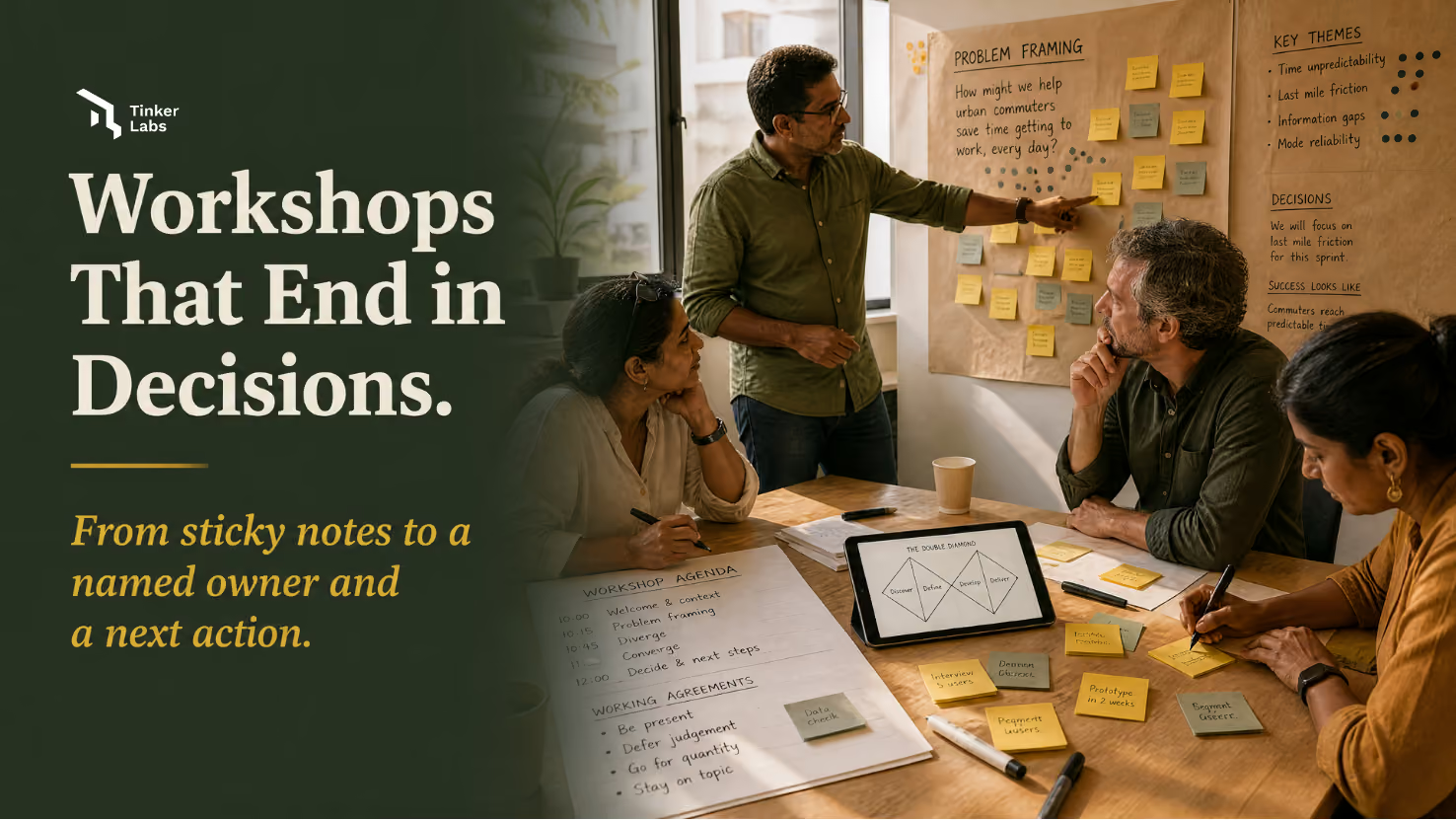
A design thinking workshop is useful for business leaders because it brings faster stakeholder alignment, sharper problem framing and better change outcomes. The strongest workshops combine human-centered design with practical facilitation to leave teams with evidence-based direction to put into action come Monday morning. And that is not the same as a brainstorming party in a prettier room.
A design thinking workshop is not meant to be a brainstorming session in a more creative room. It is a structured work session to facilitate a decision using workshop facilitation to move from ambiguity to a concrete decision. The first part of design thinking is divergence, where one first tries to come up with as many solutions as possible to understand the problem better. The second part is convergence, where one filters out the less relevant possibilities to come up with the best solution. Design Council's famous Double Diamond describes this process well.[1] Ideo describes human-centered design thinking as design thinking, and also explains in what way human-centered design is different from design thinking.[3] Human-centered design is a human-centered approach that is desirable, feasible and viable.
What makes a design thinking workshop different
The goal of a design thinking workshop is not to hold a brainstorming session and come up with a lot of ideas in a nice room. The goal is to have a working session where a team can come up with a decision in order to solve a problem for customers or end-users. A Design Thinking workshop is therefore useful for business leaders because it can lead to faster stakeholder alignment, better problem framing and better change outcomes. Hence, Design Thinking workshops are extremely useful where human-centered design meets practical facilitation in order to come up with evidence-based direction for action and have all team members leave the workshop with a lot of enthusiasm, knowing that they have worked as a team to reach a solution.
With today's Indian organizations going through tremendous change (growth, legacy systems, limited time and multiple opinions across multiple functions), an effective enterprise workshop can go a long way in reducing debate fatigue and getting sales, operations, product and service teams aligned to tackle customer problems as one team. This is where business transformation becomes real.
Who should be in the room
So the first step is to pick the right people to attend the workshop and ensure that the scope of the discussion is within bounds. This means including the decision owner/sponsor and those closest to the customer as well as functional teams who will be impacted by the resulting decisions and action. One facilitator is enough to keep the workshop on track and running smoothly. Occasionally it is helpful to bring in a specialist to ensure that sufficient evidence is gathered from areas such as research, operations and service design.
Before the room opens, define the decision
It's important to remember that before entering into the workshop, the facilitation team has written one decision statement that clearly outlines the business problem and resulting decisions in plain language. For example, "Which customer problem are we going to solve first" or "What service concept are we going to pilot next quarter." A workshop that produces decisions at the end of the workshop starts long before the meeting invite is sent out.
Use this pre-work checklist:
- State the business problem in one sentence.
- Define the decision owner.
- List the constraints that cannot move.
- Only invite those who can decide on the answer to the problem defined by the workshop.
- Collecting evidence in advance such as customer feedback, data, service metrics or even the insight of the front line staff.
This is where strategy facilitation earns its keep. A workshop that produces decisions is one where the work of decision-making has been done prior to the meeting. The workshop does not have to end in discussion and without decisions.
Build the workshop agenda around convergence
Note: An agenda for a workshop should not be too long. Instead it should have a number of steps which the participants go through in sequence. For a 2 hour or half day workshop the following is an example of a practical agenda.
- Open with the decision statement and success criteria.
- Share the evidence and the main assumptions.
- Reframe the challenge through problem framing.
- Surface options through a focused co-creation session.
- Use one or two ideation sprint exercises to widen possibilities.
- Converge with dot voting, criteria scoring, or forced ranking.
- Lock the owner and the next step.
The agenda is designed to progress through the required steps and can be mapped to the Double Diamond model of design – discover, define, develop, deliver. [2] Each step of the process builds on the previous one, but also allows for backward movement as necessary to gain greater insight into the problem at hand. Design work is not linear and thus decisions are made along the way. This is how good decisions are made.
A 90-minute sample flow
For 90 minutes or less, there is a more tightly structured sequence which goes something like this: 10 minutes to frame the decision; 15 minutes of review of all the evidence to date; 20 minutes of silent generation of written ideas by all participants; 20 minutes to sort and compare written ideas from individuals into clusters of possible solutions; 15 minutes to score or rank options against criteria for decision; and 10 minutes to lock down a decision owner and task for next steps. The key here is to have a lot of discipline to keep the process on track to preserve the momentum of the workshop without losing focus.
Facilitation techniques that keep the room honest
A selection of simple yet effective techniques that are difficult to manipulate and can be easily seen by all are critical for the facilitator to keep all participants safe and on track in a workshop to make a decision.[9] Simple human centered techniques such as silent writing before discussion, round-robin sharing, timeboxing, dot voting with a threshold, "what would have to be true?" prompts, and parking lot capture for issues that are off track for the session but critical to cover off are easy to learn and use quickly to achieve results in a workshop.
- Silent writing before discussion. Silent writing allows quieter members to have a chance to think before others discuss.
- Round-robin sharing. Everyone speaks once before anyone speaks twice.
- Timeboxing. Every activity gets a finish line.
- Dot voting with a threshold: Group chooses ideas based on agreed upon criteria rather than their popularity.
- "What would have to be true?" prompts. These help surface assumptions quickly.
- Parking lot capture. Write down off-topic items for later reference.
In human-centered design sessions there are many tools and techniques to build on the real needs and constraints of people. The basic idea behind design thinking as framed by IDEO is to balance the needs of people, technology and business to drive success for all. The various workshop formats and tools developed at Stanford's d.school also increasingly focus on how to structure collaborative design work efficiently and effectively, including through careful preparation and team structures.
Use problem framing before ideation
For a lot of workshops, the biggest failure is starting with ideation. While it sounds very active, ideas are usually shallow and not very meaningful if you started too early. So, the biggest value in workshops is usually found by spending more time in problem framing before you start generating lots of ideas.[7]
- Who is affected by this problem?
- What is the actual pain point?
- What evidence tells us this is the right problem?
- What would a good outcome change for customers and for the business?
This is where problem framing can become a business tool and no longer just a design exercise.[8] By spending enough time on the right framing questions, teams can prevent themselves from developing solutions to the wrong problems and thereby creating beautiful failures instead of meaningful business change. Design thinking consulting teams recognize this critical distinction between a great workshop and meaningful business change.
Turn ideas into decisions, not just output
Ideas generated should be turned into decisions i.e. decide how to turn concepts generated into change. This is often as simple as deciding which idea to prototype, deciding who the pilot audience for a service change idea would be, etc. This helps to keep focus and track of what has been achieved.
To turn a workshop with many ideas into a successful project, decisions have to be made on the basis of the ideas generated. To make this shift, we use the following decision checklist.
- Which option best fits the customer need?
- Which option is most feasible now?
- Which option creates the strongest business value?
- What can we test quickly?
- Who owns the next move?
This is where change outcomes become visible. Instead of only saying 'We aligned', you can say 'We chose a direction, assigned someone to work on it and now we have to pilot it'.
Where innovation consulting adds real leverage
In many instances, organizations can run their own workshops and workshops sessions. There are, however, instances where bringing in an outside innovation consulting firm can add significant value. For instance, where there are sensitive political issues involved, where teams have been locked in a series of debates with no progress made, or where senior business leaders need to be kept in check by a neutral facilitator.
A good consultant does more than keep time. They help with:
- workshop agenda design,
- workshop facilitation,
- stakeholder mapping,
- evidence synthesis,
- and follow-through after the meeting.
The key point is that the workshop must continue to drive the organization forward after the meeting room has been vacated. Enterprise workshops are decision systems, not theater.
How to know the workshop worked
Measure the workshop on decision quality, not applause. Useful indicators include:
- A clear decision was made.
- An owner was assigned.
- The next action was scheduled.
- Stakeholders agreed on the criteria used.
- The team can explain the reasons for having picked the option that they picked.
- The follow-up work began on time.
To measure the change resulting from a workshop, it is useful to follow up on the organization 30-90 days after the workshop. Some indicators to measure then are:
- Did the pilot launch?
- Did the decision reduce rework?
- Did the team move faster?
- Did the customer experience improve?
- Is the business getting better signals as to what to do next.
These are the questions to look for in the following 30 to 90 days to get a strong read on change outcomes at the change adoption workshop.
Common mistakes to avoid
Most critical is not to confuse a workshop with leadership. A workshop can clarify, align, and prioritize, but decisions have to be made by a decision maker. The workshop can support this decision maker but without him or her there is no impact.
Avoid these traps:
- inviting too many people,
- starting without evidence,
- letting one voice dominate,
- skipping the decision criteria,
- and leaving without an owner.
Designing a workshop for activity as opposed to outcome is another common mistake. At the end of the day, sticky notes do not translate to progress at the workplace. It is crucial to ensure that the team leaves with a choice, the corresponding rationale, and the next steps to ensure that they are able to put the decisions into action at the workplace.
Why this matters for business transformation
The ability to facilitate a design thinking workshop is invaluable in enterprise workshops and leadership settings. It enables teams working towards business transformation to move from abstract ambition to practical execution by ensuring that customer insight is aligned with the capability of the team and translated into action. It makes human-centered design operational, not decorative. Business under pressure benefits from a more disciplined approach to decision making at short notice.
Design thinking workshop facilitation within enterprise workshops and leadership sessions is therefore a very valuable skill. It gives the teams a common language, a structured way to work and increase their chances for choosing the right things first time around. When paired with strategy facilitation, rooms can then move from opinion to evidence, and from evidence to action.[4][5][6]
Conclusion
Ultimately a workshop can only be of value to an organization if it results in a decision. So it is no good unless it is mixed with the right amount of workshop facilitation, problem framing, techniques and shared criteria in order to create a decision engine within the workshop. Therefore, an important, cross-functional, messy problem is best tackled through a well-run design thinking workshop.
As Design Thinking workshops can help organizations decide and move towards change, it is a crucial skill for any leader and team to learn. By combining the practice with Strategy Facilitation, teams and leaders can help rooms move from opinions to evidence and from evidence to action. That is why this skill is so valuable to any organization going through Business Transformation. It helps in turning challenges into opportunities for growth and success.
References
- Design Council. The Double Diamond. Available from: https://www.designcouncil.org.uk/our-resources/the-double-diamond/. Accessed Apr 2026.
- Design Council. Framework for Innovation. Available from: https://www.designcouncil.org.uk/our-resources/framework-for-innovation/. Accessed Apr 2026.
- IDEO. What's the difference between human-centered design and design thinking? Available from: https://designthinking.ideo.com/faq/whats-the-difference-between-human-centered-design-and-design-thinking. Accessed Apr 2026.
- Stanford d.school. d.school Starter Kit. Available from: https://dschool.stanford.edu/tools/starter-kit. Accessed Apr 2026.
- Stanford d.school. Design Thinking Bootleg. Available from: https://dschool.stanford.edu/tools/design-thinking-bootleg. Accessed Apr 2026.
- Mural. Design Thinking Process Guide for Collaborative Teams. Available from: https://www.mural.co/blog/design-thinking. Accessed Apr 2026.
- Mural. How to succeed in the define stage of design thinking. Available from: https://www.mural.co/blog/design-thinking-define. Accessed Apr 2026.
- Mural. How to Succeed in the Ideate Stage of Design Thinking. Available from: https://www.mural.co/blog/design-thinking-ideation. Accessed Apr 2026.
- LUMA Institute. Recipes: the power of combining design methods. Available from: https://www.luma-institute.com/2021/09/02/recipes-power-of-combining-design-methods/. Accessed Apr 2026.
CTA: Apply This Framework to Your Next Workshop
Tinker Labs runs decision-focused design thinking workshops for leadership teams in India — using human-centered design & practical facilitation to create change & define next steps. We'd love to chat with you about a workshop for your team.
About the author

Mandeep Toor
Head of Trainings & Workshops at TinkerLabs
Mandeep helps organisations build innovation capability through design thinking and behavioural science. With over a decade in innovation and entrepreneurship, he has led 75+ workshops for leaders at firms like Piramal Group, Samsung, Flipkart, HP, and Hindustan Unilever, and teaches Design Thinking at IIMs, MICA, and SOIL Institute of Management. Know more →

