


What Is Behavioural Science Consulting? Definition, Core Functions & Real-World Examples


Short Description
Most business advice still assumes people act rationally once they have the right information, and behavioural science consulting exists because that assumption keeps breaking down in practice, which is exactly why organizations turn to a behavioural science agency in India rather than a generic strategy firm. This guide explains what the discipline actually involves, from diagnosing where a gap opens between intention and action to testing a fix in a small controlled way before scaling it. It walks through three real examples, checkout flows, workplace compliance, and patient adherence, showing what changed in each case and why it worked. It ends with a clear signal for when a stubborn conversion or compliance problem is worth treating as behavioural rather than redesigning the whole system.
Blog Summary
Behavioural science consulting is a professional service that applies research from psychology, economics, and sociology to help organizations understand why people make the choices they do, and design better products, systems, and policies around that reality. Rather than assuming people act with perfect rationality, a behavioural science consultant studies cognitive bias, subconscious drivers, and environmental context to explain and improve real-world behaviour. This guide covers what the practice actually involves, how it differs from traditional strategy consulting, three real-world behavioural science examples, digital UX, workplace compliance, and healthcare adherence, and when it makes sense to bring a behavioural science consultant in.
Introduction
Most organisations assume that if a product works, a policy is clear, or an incentive is generous enough, people will act accordingly. In practice, that assumption breaks down constantly, and the gap between what a system is designed to do and what people actually do is exactly where behavioural science consulting operates. This piece explains what the discipline actually involves, how it differs from traditional strategy consulting, and where it tends to make the biggest difference in practice.
What Is Behavioural Science Consulting?
Behavioural science consulting is a professional service that applies research from psychology, economics, and sociology to help organizations understand human choices and design better systems, products, and policies around them.
Traditional business thinking often assumes people behave rationally, that if you give them the right information or incentive, they'll act accordingly. In practice, that assumption breaks down constantly. People abandon shopping carts despite wanting the product. Employees skip safety training despite understanding the risks. Patients stop taking medication despite knowing it helps them.
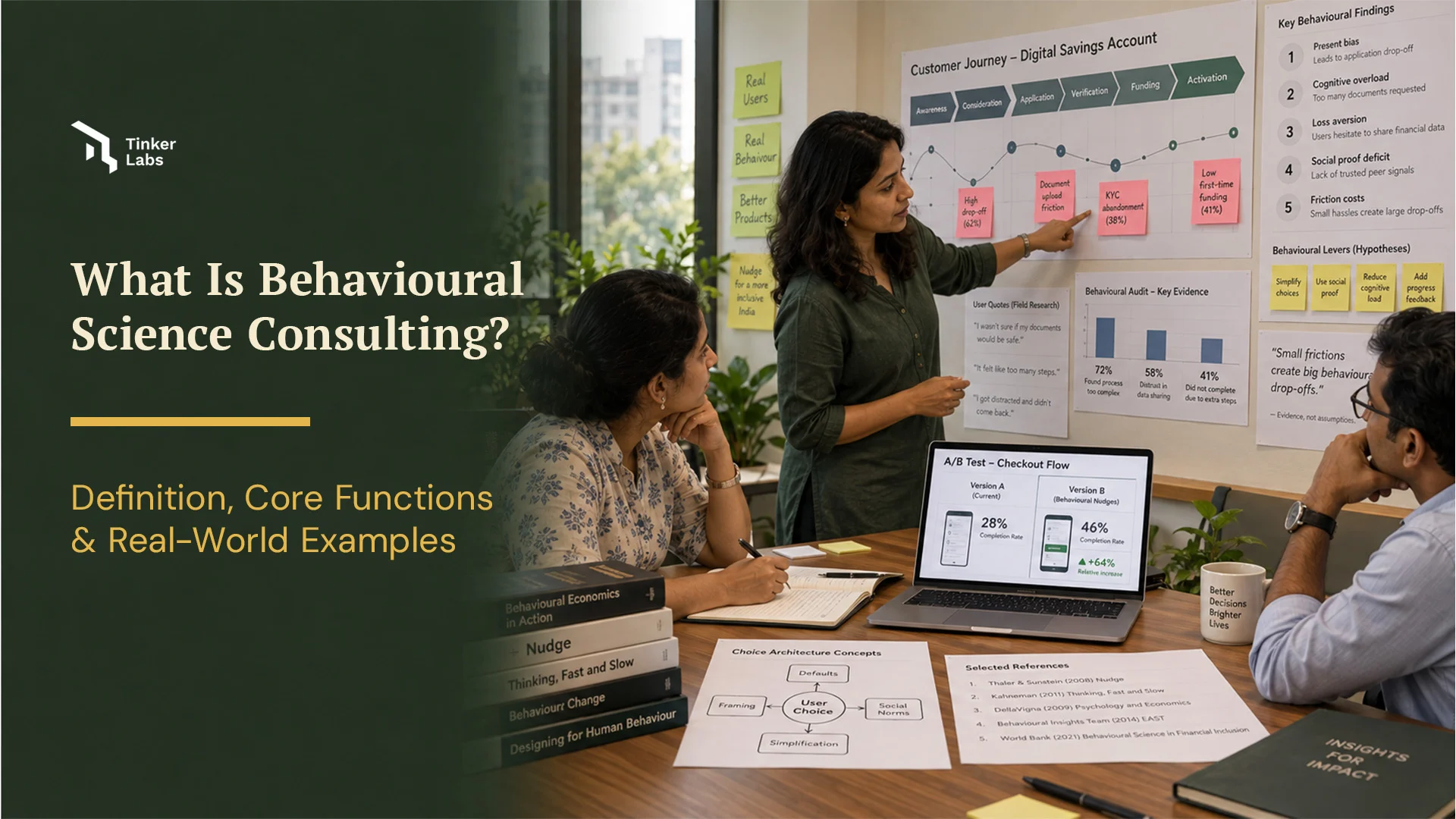
Behavioural science consultants study exactly why these gaps between intention and action happen, looking at cognitive bias, subconscious drivers, and the environment a decision is made in, and then design specific, testable behaviour change intervention work to close that gap. Organizations often approach this through specialized advisory groups, dedicated in-house behavioural design teams, or strategy firms with a behavioural science practice.
How Behavioural Science Consulting Differs From Traditional Consulting
Traditional strategy consulting typically starts from data, market analysis, and organizational structure, building recommendations from the top down based on what should logically work.
Behavioural science in business starts from a different question: how do the actual humans involved, customers, employees, citizens, really behave, and why? Instead of assuming a well-designed process or policy will be followed simply because it's well-designed, behavioural science consultants test assumptions directly, often through small controlled experiments grounded in behavioural economics, before recommending a change at scale.
This makes it less about big-picture strategy and more about the specific, often small design choices within a wider choice architecture, the wording of a reminder, the default option on a form, the timing of a nudge, that determine whether people actually do what a system is designed for them to do.
Core Functions Of A Behavioural Science Consultant
Most behavioural science consulting engagements involve three core activities, usually in sequence.
Diagnosis
Before designing any intervention, consultants first diagnose exactly why a gap exists between what people say they'll do and what they actually do. This often involves interviews, behavioural audits, and analysis of existing data to pinpoint the specific decision point where people are dropping off or behaving differently than intended, rather than assuming the cause upfront.
Experimentation
Once a likely cause is identified, consultants design small, controlled tests, often randomized controlled trial studies, to see which specific intervention actually changes behaviour, rather than relying on intuition or best practice alone. This step is what separates behavioural science consulting from generic advice: claims get tested before they get scaled.
Optimization
Once an intervention is shown to work, consultants refine it and remove remaining friction, awkward steps in a digital interface, confusing signage in a physical space, or unclear language in a policy document, that could still cause people to disengage or make an unintended choice.
Real-World Examples Of Behavioural Science Consulting
These principles show up across very different contexts. Three common examples illustrate how the same underlying discipline applies.
Improving Digital Onboarding And Checkout Ux
The challenge: an online platform wants users to complete a sign-up or checkout process without dropping off midway.
The intervention: consultants reduce the number of choices presented at any one time to reduce cognitive overload and use subtle visual cues, such as sensible default options based on nudge theory, to direct attention to the action that benefits both the user and the business.
And the result: Less user frustration and higher conversion rates, without touching the underlying product at all.
Boosting Workplace Compliance And Safety Participation
The challenge: Employees know a safety protocol is important, but they forget to complete an annual training module.
The intervention: Instead of sending mandatory reminder emails, consultants change the wording to include social proof, mentioning how many of their colleagues have already completed the task, or simply schedule the reminder for when employees have less on their plates.
The result: A communication change alone that measurably improved completion and participation rates.
Improving Patient Adherence In Healthcare
The problem: Patients forget or don’t follow post-treatment prescription instructions, which is a huge contributor to poor health outcomes and avoidable readmissions.
The intervention: designers develop simple adherence plans, text-message nudges tied to a patient’s daily routine, and clear milestone trackers instead of heavy printed instructions.
The result: better long-term health outcomes and fewer avoidable readmissions.
When Should An Organization Bring In A Behavioural Science Consultant?
Behavioural science consulting tends to add the most value in a specific situation: when a product, policy, or program is well-designed on paper, well-resourced, and still isn't producing the behaviour it was built for. If people aren't converting, complying, or adhering despite having every reason and ability to, that's usually a sign the gap is behavioural, not structural, and worth diagnosing directly rather than redesigning the whole system from scratch.
Organizations typically engage a behavioural science agency in India when they need outside objectivity and testing rigor for a specific, high-stakes decision point, a checkout flow, a compliance program, a patient journey, rather than a broad strategic overhaul. Others build this into their existing design thinking consulting practice in India, treating behavioural diagnosis as one tool within a broader human-centered design process. Teams that want to build this capability internally rather than outsourcing it often start with an innovation training program for your team, so that product, policy, and CX functions can identify and test behavioural interventions themselves going forward.
Conclusion
Behavioural science consulting isn't about persuading people to do something against their interest, it's about closing the gap between what a system is designed to do and what people actually do when they interact with it. The discipline that makes it different from generic advice is the middle step: testing an intervention in a small, controlled way before recommending it at scale.
For organizations facing a stubborn conversion, compliance, or adherence problem that hasn't responded to more information or bigger incentives, that gap is usually behavioural, and treating it as a specific, testable design problem is what makes behavioural science consulting worth the investment.
Frequently Asked Questions
1. What Is The Definition Of Behavioral Science?
Behavioral science is the scientific study of human (and sometimes animal) behavior through observation and experiment . It draws on disciplines such as psychology , economics , and sociology to figure out why people behave the way they do and sometimes when that behavior cannot be considered entirely logical .
2. What Is An Example Of Behavioral Science?
A common example is "nudging," a small, low-cost change to how a choice is presented within a broader choice architecture, such as making a beneficial option the default rather than requiring people to opt in, which measurably changes behaviour without restricting anyone's choices or changing the underlying incentives. This is one of the clearest behavioural science examples in everyday design.
3. What Are The Five Behavioral Sciences?
The behavioral sciences are typically grouped as psychology, sociology, anthropology, economics, and political science, five disciplines that each study human behaviour and decision-making from a different angle, and which behavioural science consulting draws on together rather than any single one alone.
4. What Are The Key Concepts In Behavioral Science?
Core concepts include cognitive bias (systematic patterns of deviation from rational judgment), heuristics (mental shortcuts people use to make quick decisions), nudge theory (small design changes that steer behaviour without restricting choice), and the widely-referenced distinction between System 1 and System 2 thinking (fast, intuitive versus slow, deliberate) popularized by psychologist Daniel Kahneman.
Talk To Us About Your Behavioural Gap
TinkerLabs works with organisations across India to diagnose exactly where a product, policy, or process is losing people, and to test what actually fixes it before it's rolled out at scale. Whether it's a checkout flow, a compliance program, or a patient journey, we'd love to hear what's not converting the way it should. Let's talk.
About the Author

Mandeep Toor
Head of Trainings & Workshops at TinkerLabs
Mandeep helps organisations build innovation capability through design thinking and behavioural science. With over a decade in innovation and entrepreneurship, he has led 75+ workshops for leaders at firms like Piramal Group, Samsung, Flipkart, HP, and Hindustan Unilever, and teaches Design Thinking at IIMs, MICA, and SOIL Institute of Management. Know more →

