


What Are The 7 Modes Of Design Innovation Process? A Guide To Systematic Innovation


Short Description
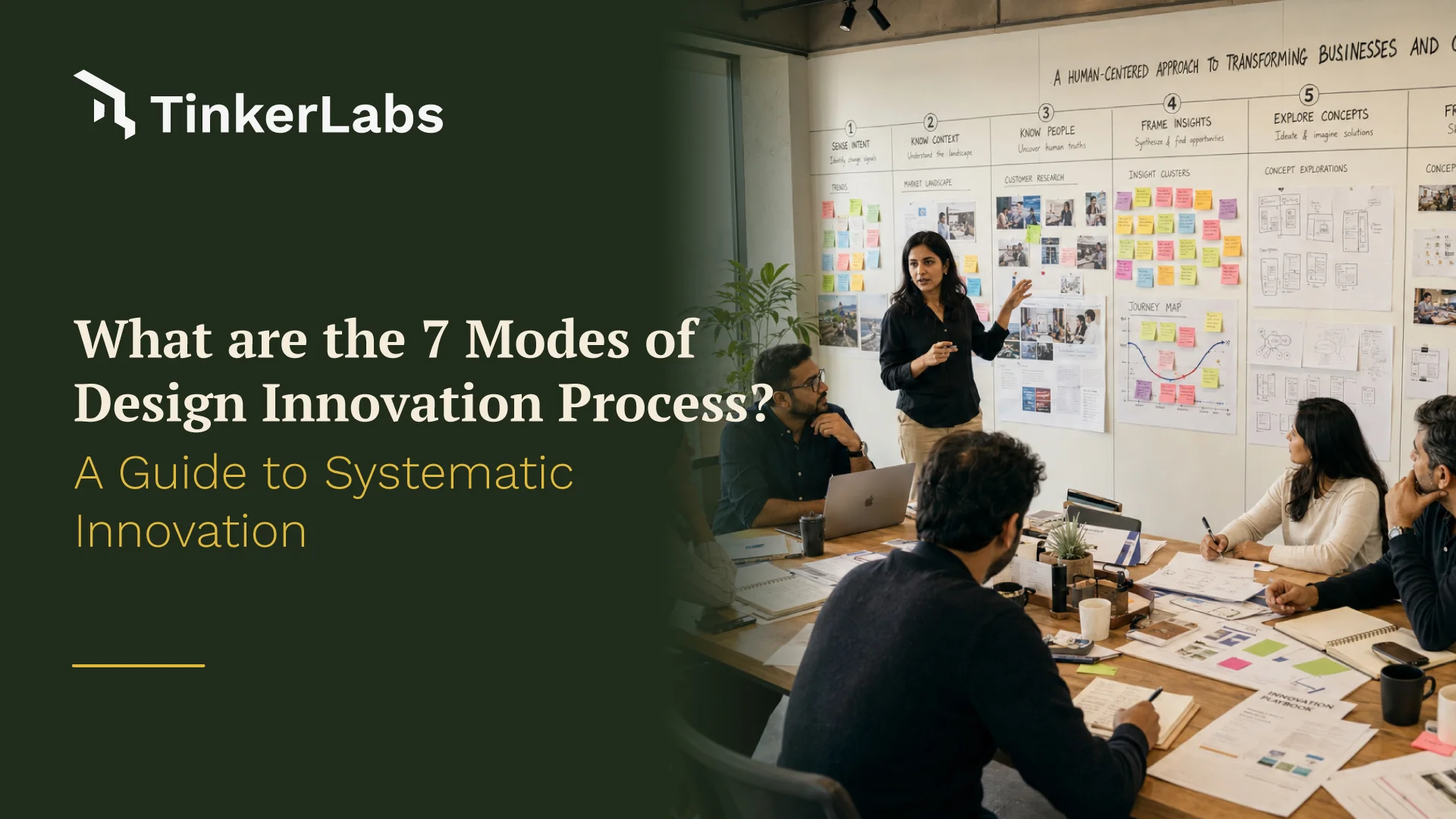
Here's a look at the 7 modes of design innovation process, a systematic innovation framework built by Vijay Kumar at the IIT Institute of Design. Each mode carries a team from abstract thinking to real-world reality, and this guide walks through how a design thinking agency actually puts analysis and synthesis to work on live business problems.
Blog Summary
Most teams already know the five-stage design thinking model by heart, but running innovation at enterprise scale takes something sturdier than a checklist. This guide goes through the 7 modes of design innovation process, starting at Sense Intent and ending at Realize Offerings. Real examples along the way, Crest Whitestrips, the Kindle, the Wii, show how the framework turns abstract thinking into commercial results that actually land. You'll also see how design thinking for business innovation plays out in practice, not just on a whiteboard.
Introduction
Ask five different teams to define design thinking and you'll probably get five slightly different answers, most of them circling back to the same five-step checklist. That checklist earns its keep on smaller projects. It starts to strain the moment a large organization tries to run innovation as a repeatable discipline instead of a one-off workshop, though, and that's the exact gap the 7 modes of design innovation process was built to close.
Vijay Kumar developed the framework at the IIT Institute of Design and laid it out in detail in "101 Design Methods." Anyone researching Vijay Kumar design thinking online will run into this same core structure repeatedly, and for good reason. The systematic innovation framework pairs abstract thinking with real-world reality, balancing analysis and synthesis at every stage so ideas actually hold up once they hit a real market instead of falling apart on contact. Below, we break down each of the seven modes, Sense Intent through Realize Offerings, and look at how a design thinking agency like TinkerLabs applies this thinking to live business challenges.
Beyond The Five Steps: Moving Towards Systematic Innovation
Modern organizations are up against problems that are complex and changing fast. Standard five-stage design thinking gives teams a solid entry point for user empathy, sure, but scaling innovation across an entire enterprise needs something more rigorous, something more data-driven. Business leaders who want predictable breakthroughs, not just a linear checklist, tend to reach for the 7 modes of design innovation process instead.
Vijay Kumar built this at the IIT Institute of Design and detailed it in "101 Design Methods." What makes it useful is the structured toolkit underneath it, one that balances abstract thinking with real-world reality, and analysis with synthesis, giving a design thinking agency a reliable bridge between concept and something that actually sells.
The Seven Modes Of Design Innovation Process Explored
Mode 1: Sense Intent — Mapping Trends And Setting Direction
This first stage is really just a strategic pause. Teams step back and watch shifting technological, business, and cultural trends before jumping into product development. Instead of rushing to build features, the goal is to look at the big picture, catch early patterns of change, reframe the problem space where needed, and land on a clear, fact-grounded direction.
Mode 2: Know Context — Understanding Market Realities And Constraints
Once there's an initial direction, teams dig into the surrounding business environment, industry history, and what competitors are actually doing. Internal capabilities get examined closely too, financial limits, IP landscape, the works, so whatever innovation strategy gets proposed actually lines up with commercial reality rather than wishful thinking.
Mode 3: Know People — Immersive User Research And Empathy
This phase goes deep on empathetic research into end-users, hunting for real human experience and needs nobody's articulated yet. Rather than leaning on quantitative dashboards, teams turn to immersive ethnographic research, direct contextual observation, and user interviews to surface motivations that a standard survey routinely misses.
Mode 4: Frame Insights — Transforming Data Into Actionable Principles
Here the process moves towards more abstract activities such as analysis, as it is necessary to sort out the huge amounts of data collected during user and context researches. Innovators search for patterns that will help to create personas and user journeys which will be used as a basis for further design.
Mode 5: Explore Concepts — Divergent Thinking And Creative Generation
From analytical parsing, the work shifts into creative generation. Teams lean on structured ideation techniques to brainstorm a wide spread of potential solutions. The core rule is keeping divergent concept generation clearly separate from convergent evaluation, that separation protects creative confidence and opens the door to radical, non-obvious ideas that get filtered out too early otherwise.
Mode 6: Frame Solutions — Prototyping And Combining Holistic Offerings
Isolated ideas rarely solve anything complicated on their own, so this is where single concepts get combined into full, holistic system offerings. Rapid prototyping, interactive user scenarios, and value proposition mapping all come into play here, giving teams low-risk working models to test how different features actually interact with each other before real capital gets committed.
Mode 7: Realize Offerings — Scalability, Viability, And Market Execution
The final stage takes the validated concept out of the design lab and into real market execution. Everything here is about long-term commercial viability, scalability, and operational sustainability, building robust business models, laying out execution roadmaps, and putting together a proper product launch strategy.
Core Mindsets And Real-World Applications
What sets this framework apart is how much weight it puts on specific cognitive mindsets, particularly during the early Sense Intent phase, things like reframing problems, foreseeing trends, and seeing overviews. History backs up how much these mindsets are actually worth commercially.
In 2001, Procter & Gamble launched Crest Whitestrips by reframing oral care entirely, from basic cavity prevention into personal cosmetic enhancement, and captured much higher profit margins doing it. Something similar happened with a trend-foreseeing mindset. Amazon showed this off in 2007 with the Kindle, pulling together concurrent shifts in electronic ink, declining publishing, and rising mobile adoption to end up dominating the e-reader market almost entirely.
Then there's seeing macro-overviews, which can spark genuinely disruptive breakthroughs on its own. Nintendo built the Wii in 2006 by ignoring the industry's usual obsession with raw processing power, looking at the bigger picture instead and expanding the total market through a simplified, gesture-based wireless interface. Organizations can structure this kind of early-stage trend discovery using methods like Buzz Reports, a self-generated news aggregation approach teams like Peapod Labs used back in 2010 to share and argue over tech and cultural reviews.
Driving Business Transformation With Tinkerlabs
At TinkerLabs, we help enterprises put design thinking for business innovation to work, turning vague organizational challenges into clear market opportunities. Whether your leadership team needs specialized behavioural science consulting to map out consumer behavior patterns, or wants to upskill internal teams through a hands-on design thinking workshop, our team brings the structured guidance and execution toolkits it takes to drive sustainable growth and get more out of your digital transformation consulting services.
Frequently Asked Questions (Faqs)
Q1: Who Developed The 7 Modes Of Design Innovation Framework?
A: The framework was developed by Professor Vijay Kumar at the IIT Institute of Design and was comprehensively detailed in his seminal textbook, "101 Design Methods". It is widely used by corporate teams and design thinking agencies to bring structural discipline to complex innovation projects.
Q2: How Do The 7 Modes Differ From Traditional 5-Stage Design Thinking Models?
A: The standard five-stage models, the d.school's Empathize-Define-Ideate-Prototype-Test, give teams a solid entry point for user empathy, but they can feel overly linear once things scale up. Kumar's 7 Modes framework is more rigorous and more data-driven. It deliberately balances abstract thinking with real-world reality and analysis with synthesis, working more like a scalable corporate toolkit than a simple checklist.
Q3: Why Is Mode 1 (Sense Intent) Considered So Critical For Business Leadership?
A: A lot of corporate failures come down to teams rushing to build features for the wrong problem entirely. Mode 1 requires a strategic break to chart out the macro trends, and rethink the base assumption to know which way the market is actually going. As Nintendo managed to create the Wii through innovative problem reframing and an overview mind, those leaders who manage to grasp such innovative mindsets will always be on track with future trends.
Q4: How Can An Organization Implement These Modes For Digital Transformation?
A: Digital transformation tends to fail when it's treated as nothing more than a tech upgrade. Applying the 7 Modes anchors digital transformation consulting services in actual human reality instead. The framework pushes companies to properly analyze operational constraints (Know Context), surface genuine user friction points (Know People), and prototype holistic ecosystems (Frame Solutions) well before a single line of heavy code gets written.
About the Author

Mandeep Toor
Head of Trainings & Workshops at TinkerLabs
Mandeep helps organisations build innovation capability through design thinking and behavioural science. With over a decade in innovation and entrepreneurship, he has led 75+ workshops for leaders at firms like Piramal Group, Samsung, Flipkart, HP, and Hindustan Unilever, and teaches Design Thinking at IIMs, MICA, and SOIL Institute of Management. Know more →
References
- RGM College of Engineering and Technology. Design Thinking, Unit 2 [Internet]. [Accessed 2026]. Available from: https://www.rgmcet.edu.in/assets/img/departments/CIVIL/materials/R19/2-2/DT/unit-2.pdf
- Pan T. The Design of Everyday Things [Internet]. 2025. [Accessed 2026]. Available from: https://tianpan.co/blog/2025-08-31-the-design-of-everyday-things
- Mural. What Is the Define Stage in Design Thinking? [Internet]. [Accessed 2026]. Available from: https://www.mural.co/blog/design-thinking-define
- KDW Creatives. What Is Design Thinking? [Internet]. [Accessed 2026]. Available from: https://kdwcreatives.com/tech/what-is-design-thinking/
Disclaimer
This article is intended for general educational and informational purposes only and does not constitute professional or consulting advice. Statistics, historical details, and examples are drawn from third-party sources current as of publication and may change over time; readers should verify current information with the original source before relying on it for business decisions. Results from applying design thinking will vary by organization, project, and execution, and no specific outcome is guaranteed. Brand and company names referenced are used for illustrative purposes only and do not imply endorsement or partnership.

