


Design Thinking Process For Enterprises: Discovery To Scale


Short Description
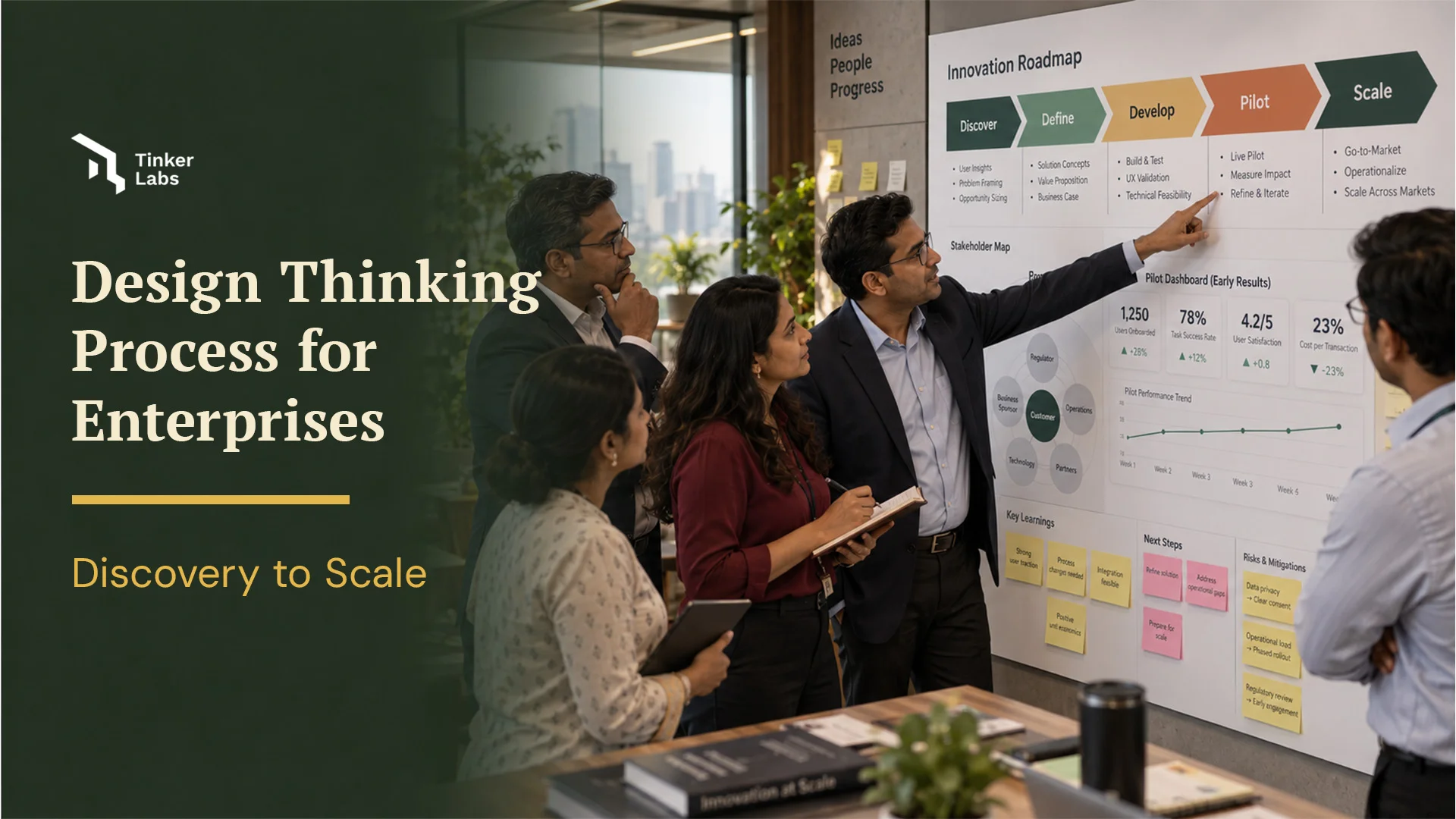
Good design thinking consulting services rest on more than a single energising workshop, and this guide lays out what a lasting process actually looks like inside a large enterprise. It walks through discovery, definition, development, piloting, and scale as one connected system, with clear outputs and metrics at every stage so teams know what good looks like before they start rather than after. Along the way it covers team composition, governance, and the mistakes that most often stall good ideas before they ever reach scale.
Blog Summary
Most people picture design thinking as a workshop with sticky notes, but inside a large enterprise the real value comes from treating it as a repeatable process rather than a one-off event. This guide walks through the full arc from discovery through definition, development, piloting, and scale, showing what deliverables and metrics should anchor each stage so momentum never comes at the cost of accountability.
It covers who needs to be in the room, the governance checkpoints that keep experimentation safe, and the common mistakes, like scaling before the operating model is ready, that quietly derail good ideas. A realistic Indian financial services example ties the whole framework together.
Introduction
Mention design thinking and most people picture workshops, sticky notes, and a fast burst of ideas. That's the surface. Inside a large enterprise, the real value shows up when design thinking becomes a repeatable way of working, not a one-off event.
Used well, it helps teams understand the problem they're solving, test ideas with real people, learn from what works and what doesn't, and decide which concepts are worth scaling. Run as a discipline rather than a single workshop, design thinking keeps organisations generating better ideas and testing them fast enough for the learning to actually compound, which is exactly what separates real enterprise innovation from a one-off exercise.
In practice, that means building a clear path from discovery through definition, development, piloting, and scale, not stopping at a one-day workshop. The strongest enterprises use this path deliberately, so that business, design, technology, and operations teams stay aligned by design, rather than by chance.
What The Design Thinking Process Means In An Enterprise Setting
At its core, the design thinking process is a human-centred way of solving complex problems. IDEO frames it as a human-centred approach to innovation,[4][5] while the Design Council's Double Diamond model organises the work into divergent and convergent phases: discovering and defining the right problem, then developing and delivering the solution.[1][2] Seen this way, human-centered design isn't a separate discipline sitting alongside design thinking for business, it's the underlying mindset the whole process is built on.
For a large organisation, the process is less about creativity and more about disciplined decision-making. It helps leaders confirm they're solving the right problem before a project loses momentum once the initial excitement wears off, and before real time and budget are spent on something that was never going to work.
The real shift happens when teams stop asking "which idea seems interesting?" and start asking "what proof do we need before we commit time and money?" That single change in question keeps teams focused, cuts duplicated effort, and makes it far easier to move from discussion to delivery.
Why Enterprises Need A Process, Not Just A Workshop
A workshop creates energy. A process creates movement. Enterprises usually need both, but shouldn't confuse one for the other. A good design thinking workshop is still a valuable entry point into this way of working, it's just not the whole system. It can surface needs, tensions, and ideas; a good process is what translates those inputs into decisions, experiments, and ownership.
Without a clear process, teams tend to leave with a wall full of ideas and no clear next step. With one, they leave with:
- A clear statement of the problem they're solving
- A testable hypothesis
- A named decision-owner
- A plan for moving into a pilot
This matters most in large organisations, where multiple teams have to agree on risk, budget, and customer impact before anything moves forward. Good governance in this context isn't red tape, it's what keeps experimentation both useful and safe.[6] This is really the governance of innovation in practice: rules that protect the business without slowing learning down. It also helps counter the corporate assumptions and internal biases that quietly derail good ideas, which is exactly where behavioural science consulting earns its place alongside design thinking.
A Practical Enterprise Design Thinking Process: Discovery To Scale
1. Discover: Understand The Real Problem
The first stage is discovery: building a clear picture of the people involved, the constraints they face, what motivates them, and how they actually behave today. Typical methods include interviews, observation, journey mapping, data review, and stakeholder conversations.
In enterprise work, discovery is never a nice-to-have research phase, it's where teams surface hidden friction, process bottlenecks, compliance constraints, and the real causes of poor adoption.
Useful outputs at this stage include:
- A problem landscape
- A user-needs summary
- A stakeholder map
- A shortlist of opportunities worth exploring further
2. Define: Frame The Opportunity Clearly
The define stage turns observations into a precise challenge, this is where strong problem framing pays off. Instead of a vague brief such as "improve customer experience," teams should describe who is struggling, what is happening, why it matters, and how success will be measured.
A good definition prevents a lot of waste later. It also makes stakeholder alignment easier, because the team is debating one problem, not four different interpretations of it.
Practical deliverables include a "How might we" statement, success metrics, an assumptions list, and a decision on which concept moves into a sprint cycle.
3. Develop: Generate And Shape Solutions
This is where ideas take shape and prototypes get built. The goal isn't a polished solution, it's several credible options, weighed against desirability, feasibility, and viability, so the team can compare paths rather than commit to the first one that sounds right.
In an enterprise setting, each lens carries its own hurdle:
- Desirability: do people actually want this, or are we designing around internal assumptions?
- Feasibility: can existing technology, legacy systems, and compliance requirements actually support it?
- Viability: does it justify itself commercially, and can that case be made to executive stakeholders?
Good teams hold both modes at once: thinking broadly to generate options, then narrowing based on evidence, strategic fit, and feasibility, essentially weighing desirability feasibility viability together rather than one at a time. Stanford d.school's Design Thinking Bootleg is a useful reference here, offering a wide set of methods for doing exactly that.[3]
In an enterprise setting, you don't need a polished prototype to surface the big problems. A rough journey mock-up, a service blueprint, a clickable screen flow, or simply role-playing a new process can be enough to reveal what might go wrong, helping you catch the major risks early and adjust before things get expensive to unwind.
4. Pilot: Test In A Controlled Environment
This is where ideas meet reality. A pilot needs to stay small enough to manage, but large enough to produce real signal. The goal is to learn from what people actually do, not what you expect them to do, and to adjust based on that evidence rather than assumption.
A strong pilot program defines:
- The user segment and scope
- Timeline and owner
- Measurement method and escalation route
- What counts as success, what counts as a warning sign, and what would trigger a stop or revise
This is also where measurement becomes critical, adoption friction, turnaround time, error rates, complaints, conversion, or whatever metric best reflects the business problem being solved.
5. Scale: Turn Learning Into Repeatable Change
Scaling does not mean copying the pilot everywhere overnight. It means preparing the organisation to adopt the solution with the right training, systems, standards, support, and ownership.
This is where the implementation roadmap matters. Leaders should decide what must change in policy, technology, service design, communications, and capability building before expanding the solution.
Done well, design thinking isn't about landing one great idea, it changes how the whole company works: better decisions, more learning from the people who use the product, and smoother collaboration across teams. That compounds into many good changes, not just one.
What To Measure At Each Stage
Design thinking earns its keep in the numbers, not just the story. A simple way to keep every stage honest is to agree what "good" looks like before you start:
- Discover: breadth and quality of insight, number of user interviews or observations completed, and how many genuinely new problems or frictions were surfaced.
- Define: clarity of the problem, whether the team can state the challenge in one sentence, and whether stakeholders agree on the success metric.
- Develop: strength of the options, number of credible concepts scored against desirability, feasibility, and viability, and how quickly weak ideas were eliminated.
- Pilot: real-world signal, adoption rate, error or complaint rates, turnaround time, and conversion, measured against a baseline.
- Scale: durability of the change, training completion, system and policy readiness, and whether the improvement holds once the pilot team's attention moves elsewhere.
Agreeing these measures upfront, not after a stage is finished, is what keeps a design thinking process accountable to the business, not just to the team running it.
How To Run The Process With The Right People
Getting the right people in the room matters as much as the process itself. A well-rounded team typically includes:
- A sponsor who protects time and budget
- A facilitator who keeps the process structured
- A researcher who brings evidence, not opinion
- A product or service owner who turns decisions into action
- Operations and technology representatives who keep the team honest about feasibility and delivery
- Someone close to the customer, to keep the room anchored in real needs
In large organisations, most ideas don't fail for lack of merit, they fail because of poor handoffs, unclear ownership, or missing organisational support.
One practical rhythm is simple: discover in week one or two, define in week three, develop concepts in week four, run a pilot in the following weeks, and review the evidence at a formal governance checkpoint. The timing can flex, but the logic should stay stable.
Common Mistakes That Weaken Enterprise Outcomes
- Starting with a solution instead of a problem
- Treating a workshop as the finish line
- Ignoring user evidence in favour of internal opinion
- Running a pilot without clear success metrics
- Failing to plan how the change will stick after the idea is approved
- Scaling too early, before the operating model is ready
The biggest risk is over-engineering the process itself. You don't need to document everything, you need a simple structure that supports good decisions, and the room to learn from what doesn't work.
Example: A Realistic Enterprise Rollout In India
Imagine a mid-sized Indian financial services company trying to reduce drop-offs in a digital onboarding journey. The team begins with discovery, talking to customers, agents, compliance staff and call-centre teams, and finds that most drop-offs are not due to lack of interest, but confusing document requests and unclear status updates.
In the define stage, they frame the issue around "helping first-time applicants complete onboarding with less friction." In develop, they create a few low-fidelity service concepts, including a simpler document checklist and a proactive status-update flow. In the pilot, they test the ideas in one region before expanding.
If the pilot succeeds, more applicants completing onboarding, fewer support calls, less rework, the team moves to a scale plan covering training, system updates, and new customer-communication templates.
Conclusion
A good design thinking process keeps organisations on track as they move from exploring ideas to testing and acting on them, combining empathy, problem framing, prototyping, testing, and governance into one coherent system, so momentum doesn't come at the cost of accountability.
Done well, it speeds up learning, aligns teams, and makes new ideas more credible to the people who have to fund and approve them. Most importantly, it turns good ideas into decisions that lead to real change.
References
- Design Council. The Double Diamond. (Accessed on Sept 2026). Available from: https://www.designcouncil.org.uk/our-resources/the-double-diamond/
- Design Council. Framework for Innovation. (Accessed on Sept 2026). Available from: https://www.designcouncil.org.uk/our-resources/framework-for-innovation/
- Stanford d.school. Design Thinking Bootleg. (Accessed on Sept 2026). Available from: https://dschool.stanford.edu/tools/design-thinking-bootleg.
- IDEO. Design Thinking. (Accessed on Sept 2026). Available from: https://designthinking.ideo.com/.
- IDEO. Human-Centered Design FAQ: What's the difference between human-centered design and design thinking? (Accessed on Sept 2026). Available from: https://designthinking.ideo.com/faq/whats-the-difference-between-human-centered-design-and-design-thinking.
- OECD. Governance of Innovation Systems. (Accessed on Sept 2026). Available from: https://www.oecd.org/content/dam/oecd/en/publications/reports/2005/08/governance-of-innovation-systems_g1gh5aee/9789264011038-en.pdf.
Bring This Process Into Your Enterprise
TinkerLabs works with leaders across India to solve problems using design thinking, helping teams understand problems, generate ideas, test them, and scale what works. Our design thinking consulting services turn unclear ideas into measurable change. If you'd like to bring this approach to your next project, let's talk about how we can help.
About the Author

Mandeep Toor
Head of Trainings & Workshops at TinkerLabs
Mandeep helps organisations build innovation capability through design thinking and behavioural science. With over a decade in innovation and entrepreneurship, he has led 75+ workshops for leaders at firms like Piramal Group, Samsung, Flipkart, HP, and Hindustan Unilever, and teaches Design Thinking at IIMs, MICA, and SOIL Institute of Management. Know more →

