


Mastering The 4 Phases Of Design Thinking: A Framework For Human-Centric Innovation


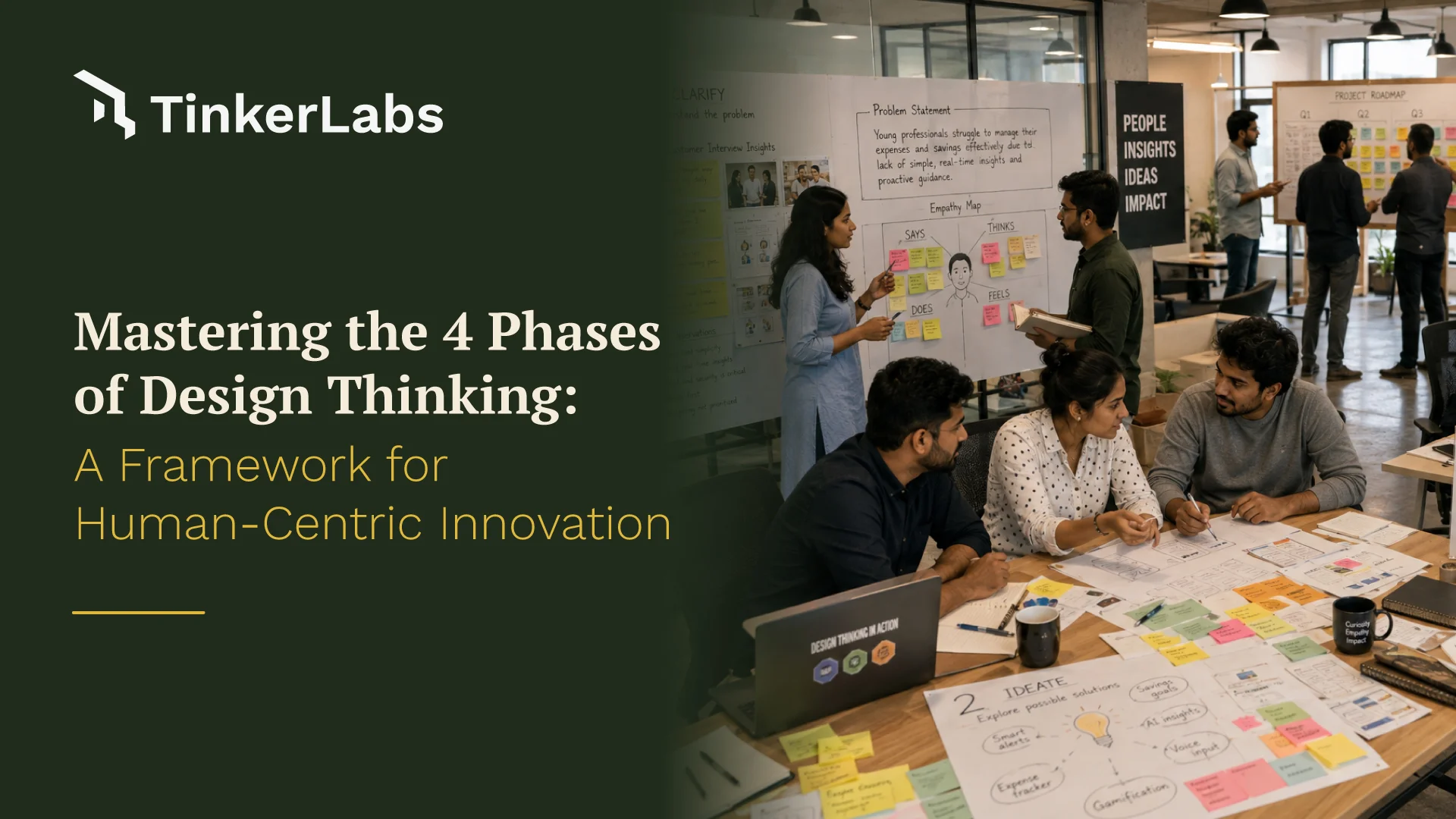
Short Description
Move past guesswork with the 4 phases of design thinking wich include Clarify, Ideate, Develop, and Implement. This human-centric innovation framework helps teams write a sharper problem statement, shift from analysis to synthesis, and build an empathy blueprint that actually reflects customer friction.
Blog Summary
Most corporate innovation stalls out because teams start with a metric instead of a person. This piece breaks down the 4 phases of design thinking, a design thinking framework built around real human needs rather than arbitrary targets. You'll see how root cause analysis and an empathy blueprint sharpen the problem statement stage, how cognitive fixedness gets broken down during ideation, and how rapid prototyping de-risks development before anything actually launches.
Introduction
Ask any product team why their last launch fell flat, and metric-first thinking is usually buried somewhere in the answer. Chasing a conversion number or an engagement target before understanding the actual person on the other end is a fast way to build something nobody needed in the first place. The 4 phases of design thinking offer something sturdier, a human-centric innovation framework used by institutions like Harvard Business School Online and the UK Design Council. Rather than a loose creative process, it organizes work into four clear operations: Clarify, Ideate, Develop, and Implement.
This guide walks through how teams move from analysis to synthesis, build an empathy blueprint to surface customer friction, and sidestep the usual traps of premature criticism and over-engineered prototypes. Think of it as a practical route from a vague hunch to something validated and actually ready to launch.
The Pitfall Of Metric-First Innovation
A lot of corporate innovation efforts fail before they even really start, mostly because teams end up focused on the wrong challenge entirely. In a typical corporate setup, projects get launched with an immediate focus on performance indicators, raising conversion rates, cutting operational overhead, hitting some engagement target pulled from a spreadsheet. Those metrics matter, sure, for bottom-line growth they matter a lot. But using them as the starting point for product development creates a blind spot that's easy to miss: it puts the business's immediate goals ahead of what the actual person using the product needs.
Build something purely to move a corporate metric, and teams inevitably end up designing elegant solutions to problems real users don't actually have. That mismatch shows up later as wasted resources, weak adoption, and a frustrated development team wondering what went wrong. Breaking out of that metric-first trap takes a deliberate pivot, one that grounds every technical and business decision in genuine human empathy instead.
The 4-Phase Architecture
Design thinking gets taught most often as a five-stage model, but there's an alternative, an official four-phase framework used by institutions like Harvard Business School Online and the UK Design Council, that offers a more structured, actionable path to innovation. For organizations looking at a professional design thinking agency, this format takes the usual non-linear creative journey and compresses it into four distinct, logical operations: Clarify, Ideate, Develop, and Implement.
Fold the traditional design steps into this leaner four-part structure, and organizations end up with a clear line of sight running from initial customer field research all the way through to final product deployment. The whole thing works as a rigorous, repeating cycle, one where teams keep challenging standard industry assumptions, validating ideas early, and de-risking the product development process as they go.
Deconstructing The Four Core Phases
1. Clarify: Understanding The Problem
The main job of the Clarify phase is diagnosing the actual root cause of a problem before anyone tries to build a solution for it. This stage acts almost like a gate, making sure the team is going after genuine human friction rather than a surface-level symptom. Companies working with strategic design thinking consulting learn to approach user issues without bringing their own bias to the table first. This phase involves:
- Empathize with Users: Teams gather primary qualitative data through one-on-one interviews, open-ended surveys, and shadowing consumers directly in their natural environment to catch motivations nobody's actually said out loud.
- Combine the Raw Data: Designers bring all the researched data, quotes, and observations together into one place in order to discover any underlying patterns, frustrations, and inconsistencies of emotion.
- Define the Problem Statement: Finally, the process comes to its end with formulating a problem statement from the synthesized data, which will serve as a guiding star for the entire project.
2. Ideate: Generating Creative Solutions
Once the problem space is properly defined, the team shifts gears, moving from analytical diagnostic work into open-ended creative exploration. The main rule of the Ideate phase is simple: prioritize high solution volume while actively breaking down cognitive fixedness.
Feedback and criticism cannot be tolerated during the early brainstorming process, as premature evaluation tends to stifle creativity and reduce productivity rapidly. In order to move beyond easy solutions, there is a need to rely on special techniques of ideation. For example, such a brainstorming technique as “Worst Possible Idea” purposely reduces performance pressure on participants, while such a technique as "Crazy Eights" requires drawing eight different solutions within eight minutes. Having identified ideas, cross-referencing to the initial problem statement allows team members to identify commonality among concepts and select promising ones.
3. Develop: Bringing Ideas To Life
The Develop phase transforms the intangible ideas captured on sticky notes and conceptualized ideas into something tangible. This stage focuses on rapid and inexpensive trials that attempt to answer fundamental questions regarding feasibility and desirability of the product.
Teams build quick, inexpensive models, paper sketches, cardboard mockups, basic digital wireframes, role-playing scripts, whatever makes the concept tangible fastest. These rough prototypes go straight into the hands of real consumers, and teams watch how people naturally interact with them without explaining how anything's supposed to work. Designers jot down what worked, what confused people and what fell apart entirely and then use those learnings to refine, rebuild or pivot the concept entirely.
4. Implement: Launching And Iterating
The final phase is about scaling the validated concept and getting it out to the wider market smoothly. Within a genuine design thinking framework, launch day is never treated like a finish line, it's really just the start of an ongoing refinement cycle.
The team finalizes production code, scales manufacturing, or refines whatever operational service model gets the solution into the real market. Organizations need to clearly explain the core, human-centric benefits of the design, both to internal stakeholders and to the target audience itself. Finally, product owners track adoption metrics and key performance indicators to confirm the solution actually solves the original problem statement, feeding real-world data back into continuous updates.
Moving From Analysis To Synthesis
Pulling this framework off successfully takes a deliberate cognitive shift between the first two phases, moving from analysis to synthesis. A lot of teams stumble here because they treat data collection and problem definition as basically the same task, which creates strategic bottlenecks down the line. Applying design thinking for innovation means understanding this structural split clearly.
Mapping The Empathy Blueprint
In the Clarify phase, the Empathy Map is one way that the team can structure the disorganised data collected through qualitative research to facilitate the smooth move from analysis to synthesis. The Empathy Map is a process of breaking down the information collected from the observations made on the customer into four different quadrants:
- Said: Record the actual words and quotes that the customer provided during field research or interviews.
- Did: Document the precise physical behaviors, actions, and workarounds observed when the user interacts with an existing system.
- Thought: Infer what the user is thinking based on their core beliefs, underlying motivations, personal goals, and unstated needs.
- Felt: Capture the user's emotional responses, tracking subtle shifts in body language, tone of voice, or hesitation.
Map these four quadrants on a shared board, and contradictions tend to jump out fast, a user saying a process is easy while their actions and body language tell a completely different story. These exact behavioral gaps become the foundation for new, high-value insight into customer challenges.
Real-World Shift: The Nutrition App Scenario
To see human-centered problem definition play out in practice, take the development of a health and wellness platform. A typical metric-first corporate approach focuses almost entirely on immediate business targets, while a design-thinking approach frames that exact same project around the realities of user behavior instead.
The Metric-First Approach: “Our aim is to boost mobile app downloads by 5% in the next quarter through optimising our user acquisition funnel.”
That statement is squarely corporate-centric. It gives the product team no real guidance on why a customer would even want to download the software, or what daily frustration it might actually solve for them.
The Human-Centered Pivot: With so many schedules to juggle, food logging becomes a huge chore, and busy parents need a quick and easy way to log their child’s daily nutritional intake.
This version shifts the whole focus onto the user's daily reality. It names a specific target user (busy parents), a core need (fast nutrition logging), and a clear emotional friction point (feeling overwhelmed). Frame the project around needs like these, and the design team suddenly has the context to build features people will actually keep using over time.
Common Mistakes To Avoid
Organizations chasing more value from their innovation efforts often look toward specialized executive training. A comprehensive design thinking training India program tends to help corporate leaders steer clear of a few common implementation missteps:
- Allowing Premature Criticism: Bringing negative feedback or skepticism into early brainstorming rounds kills team creativity fast. Ideation needs a psychological safety zone where quantity matters more than quality, at least at first.
- Over-Engineering Early Prototypes: Pouring a lot of time and effort into high-end prototypes right from the start is an error that teams make all the time. Keep your early prototypes cheap and disposable so that you can be flexible about changes.
- Treating Deployment as a Static Destination: Assuming the design process wraps up at launch is a major misstep. Design thinking depends on ongoing optimization loops built from post-launch feedback, refining the user experience continuously rather than once and done.
Frequently Asked Questions
1. What Are The 4 Stages Of Design Thinking?
The four stages are Clarify, Ideate, Develop, and Implement. For teams running a specialized design thinking workshop, this format structures innovation by identifying the root causes of human problems first, brainstorming wide-open solutions without early bias, building low-fidelity models, and rolling out products with a clear strategy for continuous market iteration.
2. What Are The 4 Phases Of The Design Process?
The four phases in professional product design are usually based on the Double Diamond model, popularised by the UK Design Council: Discover, Define, Develop, and Deliver. The approach balances divergent thinking (deep thinking of issues) and convergent thinking (highly focused action) to make a clear mapping of the problem and solution spaces.
3. What Are The 4 Pillars Of Design Thinking?
The foundation for a successful design thinking culture comprises four pillars, namely: Empathy (ensuring that humans' needs are always at the center of all decisions being made in terms of designing); Collaboration (the teamwork involved when bringing together different and multidisciplinary teams); Inclusion (adopting various unconventional perspectives); and Iteration (constant testing and refining).
4. What Are The 4 D's Of Design Thinking?
The 4 D's represent the specific operational stages of the Double Diamond innovation framework: Discover (researching the user landscape directly to gain deep insight), Define (condensing raw research data into a clear problem statement), Develop (ideating and mocking up potential solutions), and Deliver (testing variations at a small scale and scaling what works).
About the Author

Mandeep Toor
Head of Trainings & Workshops at TinkerLabs
Mandeep helps organisations build innovation capability through design thinking and behavioural science. With over a decade in innovation and entrepreneurship, he has led 75+ workshops for leaders at firms like Piramal Group, Samsung, Flipkart, HP, and Hindustan Unilever, and teaches Design Thinking at IIMs, MICA, and SOIL Institute of Management. Know more →
References
- Zight. What Is the Define Stage in Design Thinking? [Internet]. [Accessed 2026]. Available from: https://zight.com/blog/design-thinking-define-stage/
Disclaimer
This article is intended for general educational and informational purposes only and does not constitute professional or consulting advice. Statistics, historical details, and examples are drawn from third-party sources current as of publication and may change over time; readers should verify current information with the original source before relying on it for business decisions. Results from applying design thinking will vary by organization, project, and execution, and no specific outcome is guaranteed. Brand and company names referenced are used for illustrative purposes only and do not imply endorsement or partnership.

