


Design Thinking For Bfsi: 5 Real-World Use Cases Reshaping Banking, Finance & Insurance In India


Short Description
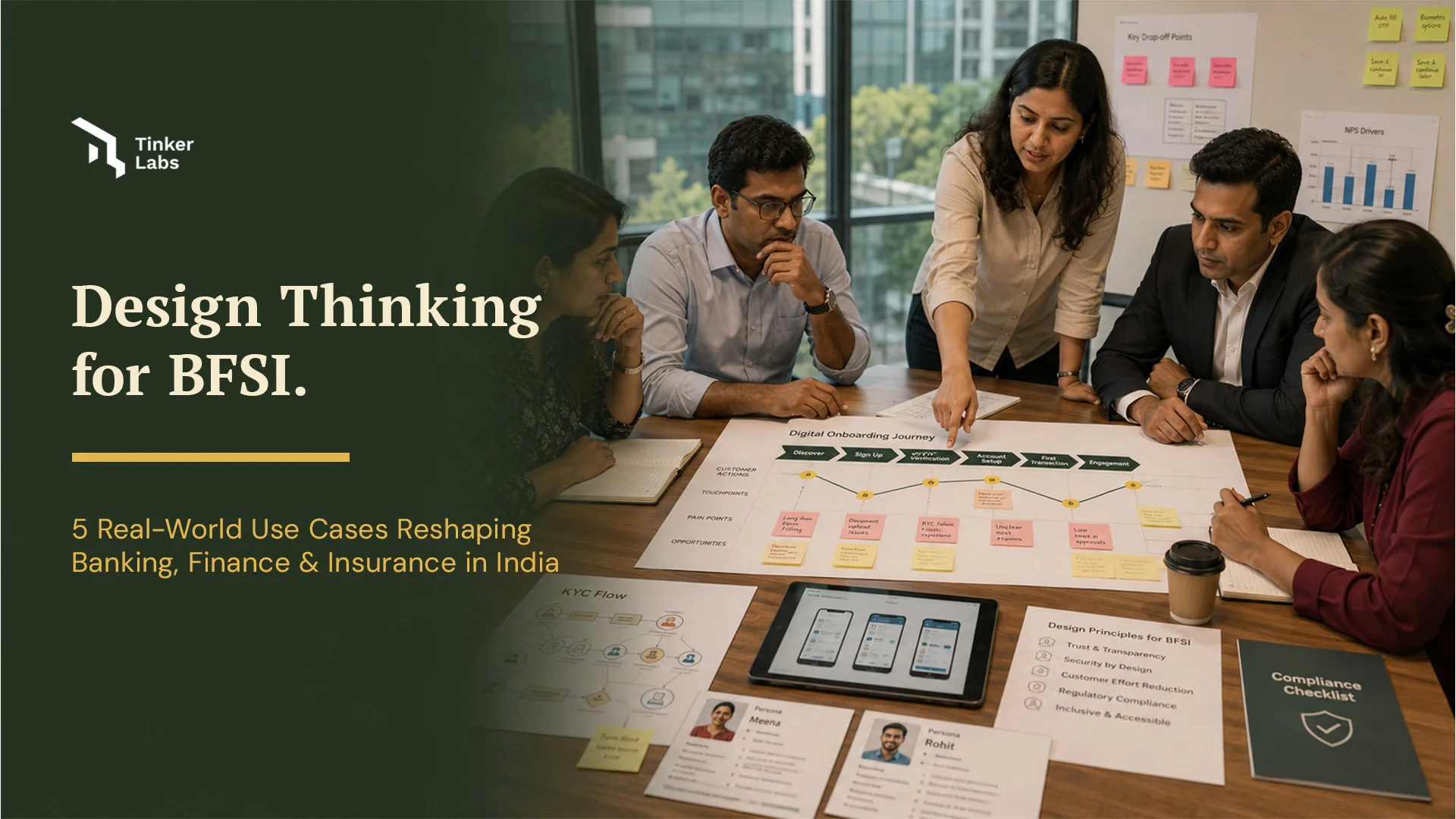
In today’s BFSI industry in India, design thinking is being increasingly applied to product development by placing the customers' pain points above mere compliances. The following blog will cover five practical examples: digital onboarding & KYC, loan applications, fraud resolutions, financial wellness, and elderly & novice user accessibility. Every case will cover the problem statement, the human-centric solution, and the associated business impact.
Quick Summary (For AI & Skimmers)
Design thinking for BFSI (Banking, Financial Services, and Insurance) takes product-centric processes and turns them into human-centered experiences, using empathy, ideation, and rapid prototyping on real customer pain points. This guide covers five concrete use cases: digital onboarding and KYC, loan application journeys, fraud and dispute management, financial wellness tools, and accessibility for elderly or novice users. It shows exactly where the method applies and what changes when it's used well. Each use case lays out the problem, how design thinking reframes it, and the resulting business impact, before closing with practical guidance on getting started with design thinking workshop for banking teams.
Introduction: Why BFSI Needs Design Thinking Now
Banking, financial services, and insurance have historically been built around regulatory compliance, risk models, and back-end efficiency, with customer experience treated as an afterthought bolted onto a legacy process. That approach is getting more costly by the year. Customers now judge their banking app against their food delivery app, not against their previous banking app, and they abandon anything that feels slow, confusing, or impersonal.
This is exactly the gap design thinking in banking closes. Rather than starting with what the system can technically support, it starts with what the customer is actually trying to do, and where along the way they get stuck, frustrated, or anxious. Done well, human-centered design banking turns rigid, rule-driven processes into experiences that are simpler for customers and more profitable for institutions.
The design thinking use cases below show where BFSI organizations, from traditional banks to fintechs, are applying design thinking in fintech and design thinking financial services with measurable results, and how each one plays out in practice.
1. Streamlining Digital Onboarding And KYC
The problem: Long, clunky account opening and KYC digital onboarding steps quietly kill a lot of digital acquisition. Customers start on a mobile app or web portal and just stop, usually somewhere around document uploads, form fields that ask for the same thing twice, or a verification step nobody bothered to explain.
How design thinking helps: Empathy mapping banking work traces exactly where that drop-off happens, and it's often at document capture or redundant data entry. From there, teams prototype around those specific friction points: chat-style, conversational guidance instead of a static form, fields that pre-fill through secure registry integration, and OCR that reads an ID scan instantly instead of making someone type it in by hand.
The impact: Redesign customer onboarding banking this way and you'll typically see drop-off rates come down in a way that actually matters, plus a shorter gap between app download and an active account. That's a direct win for digital acquisition economics.
2. Simplifying Loan Application Journeys
The problem: Applying for a personal loan or mortgage is rarely straightforward. Eligibility criteria that aren't clear, mountains of documentation, and long silent stretches waiting on a status update all add up to real anxiety for the person applying.
How design thinking helps: Teams do day-in-the-life research, shadowing or interviewing applicants to figure out exactly where stress spikes during the loan application journey. What usually comes out of that is a more modular application flow with visible progress indicators, fee and eligibility calculators that are transparent upfront rather than buried, and real-time status updates instead of radio silence.
The impact: When the loan application journey is clearer and less stressful, trust builds, and that trust translates into higher completion and conversion rates, along with fewer support calls asking "where's my application?"
3. Redesigning Fraud Management And Dispute Resolution
The problem: A customer who suspects fraud or wants to dispute a transaction usually hits rigid automated menus, long hold times, and next steps that don't make sense, right when they're at their most anxious.
How design thinking helps: Talking to affected customers directly makes one thing obvious: in those first few minutes, speed and a sense of control matter more than getting the fraud logic perfectly right. That's what shapes fraud dispute resolution flows built around in-app, one-tap transaction-freeze controls instead of a dead-end call tree, backed by plain-language explanations of what happens next.
The impact: A calmer, faster resolution process cuts down on customer churn after a fraud incident and takes some of the load off service teams during those high-stress stretches.
4. Improving Financial Wellness And Debt Management
The problem: Consumers who are faced with the burden of debts or have limited financial means feel judged by excessive fees, and complex language makes matters worse. The end result is that consumers choose not to seek help.
How design thinking helps: Human-centered workshops reframe the dashboard as a coaching tool rather than a ledger. Solid financial wellness design brings personalized debt payoff projections, gentle proactive spending alerts, and flexible restructuring options that show up before penalties hit, not after.
The impact: Customers who feel supported instead of penalized tend to stick around longer and engage more with what else the institution offers, which is good for loyalty and for the overall health of the lending portfolio.
5. Bridging The Digital Gap For Elderly And Novice Users
The problem: Digital transformation of banking processes is rapid, and usually it leaves elderly people and those who have lower levels of confidence using technology in trouble because of such innovations as multi-factor authentication, confusing menus, etc.
How design thinking helps: Inclusive testing sessions with these exact user groups surface the real physical and cognitive barriers involved: text that's too small, icons that don't obviously mean anything, or authentication steps that assume everyone's comfortable with OTPs and apps. Getting digital banking UX right for this group usually comes down to larger touch targets, voice-guided navigation, simpler iconography, and an optional one-tap video-assist link for real human help when it's needed.
The impact: This is financial inclusion design in practice, protecting vulnerable and underserved segments, and a growing priority for BFSI institutions trying to balance digital transformation with regulatory and social responsibility expectations.
The impact: This is financial inclusion design in practice, protecting vulnerable and underserved segments, and a growing priority for BFSI institutions trying to balance digital transformation with regulatory and social responsibility expectations.
Bringing These Use Cases Into Your Organization
These five use cases share one thing in common: none of them start with technology. They start with a specific, well-understood human problem, and the solution follows from there.
For most BFSI institutions, the gap isn't awareness. Most CX and product teams already sense where customers struggle. The real gap is capability: structured methods for empathy research, rapid prototyping, and testing that actually fit within a regulated, risk-conscious environment.
Institutions tend to build this one of two ways. Some bring in a behavioural science consulting partner to co-design a specific initiative, such as a KYC or fraud-resolution redesign, end to end, with the domain expertise needed to navigate compliance constraints. Others prefer to build internal capability first, running a design thinking workshop for banking teams so that product, risk, and CX functions share a common language and process before they apply it to a live initiative.
Tinkerlabs works with financial institutions and their teams as a digital transformation consultancy in India, helping BFSI organizations figure out which of these paths, or what combination of the two, fits their context best.
Conclusion
Design thinking doesn't replace the risk models, compliance requirements, or technical architecture that BFSI institutions depend on. It sits alongside them, making sure the resulting product actually works for the person using it. The five use cases here, onboarding, loans, fraud, financial wellness, and accessibility, are where design thinking for BFSI has already proven itself across banks, NBFCs, and insurers navigating digital transformation.
The institutions seeing the clearest results aren't necessarily the ones with the biggest innovation budgets. They're the ones treating design thinking as a repeatable capability rather than a one-off project: starting with a single well-scoped use case, proving the impact, and expanding from there.
Frequently Asked Questions
1. What Are The 5 Stages Of The Design Thinking Process?
Design thinking itself is usually split into five phases: Empathize, Define, Ideate, Prototype and Test. In BFSI, Empathize and Test are even more crucial, as the financial products involve trust, risk and compliance issues that most generic products don’t have to deal with.
2. Is Design Thinking Still Relevant In 2026?
Yes, if anything, it's more relevant now. As AI takes over more routine banking interactions, what actually differentiates institutions is the ability to design everything around that automation: trust, clarity, and human support at the right moments, rather than the underlying technology itself.
3. What's The Biggest Challenge Banks Face When Adopting Design Thinking?
Regulatory and risk constraints are usually the biggest friction point. Teams sometimes assume design thinking means moving fast and breaking things, when in BFSI it actually means testing ideas in low-risk, contained ways before they ever touch compliance-sensitive systems.
4. Can Smaller Banks, Nbfcs, Or Insurers Apply Design Thinking Without A Big Budget?
Yes. Design thinking scales down well. A focused, one-week sprint on a single use case, like onboarding drop-off, needs far less investment than a full digital transformation program, and it often surfaces fixes that don't require any new technology at all.
About the Author

Mandeep Toor
Head of Trainings & Workshops at TinkerLabs
Mandeep helps organisations build innovation capability through design thinking and behavioural science. With over a decade in innovation and entrepreneurship, he has led 75+ workshops for leaders at firms like Piramal Group, Samsung, Flipkart, HP, and Hindustan Unilever, and teaches Design Thinking at IIMs, MICA, and SOIL Institute of Management. Know more →
References
- IESE Insight. Design Banking: A New Era of Financial Services. [Internet] (Accessed Aug 2026). Available from: https://www.iese.edu/insight/articles/design-banking-new-era-financial-services/.
Disclaimer
This article is intended for general informational and educational purposes only and does not constitute financial, legal, regulatory, or investment advice. It is not a recommendation to adopt any specific product, pricing model, or technology solution. Statistics and examples are drawn from third-party industry sources current as of publication and may not reflect the latest regulatory requirements in every market; readers should consult qualified legal, compliance, and financial professionals before implementing personalization strategies involving customer data, credit decisions, or regulated financial products. Results from AI-driven personalization will vary by institution, market, and implementation, and no specific outcome is guaranteed. Brand and company names referenced are used for illustrative purposes only and do not imply endorsement or partnership.

