


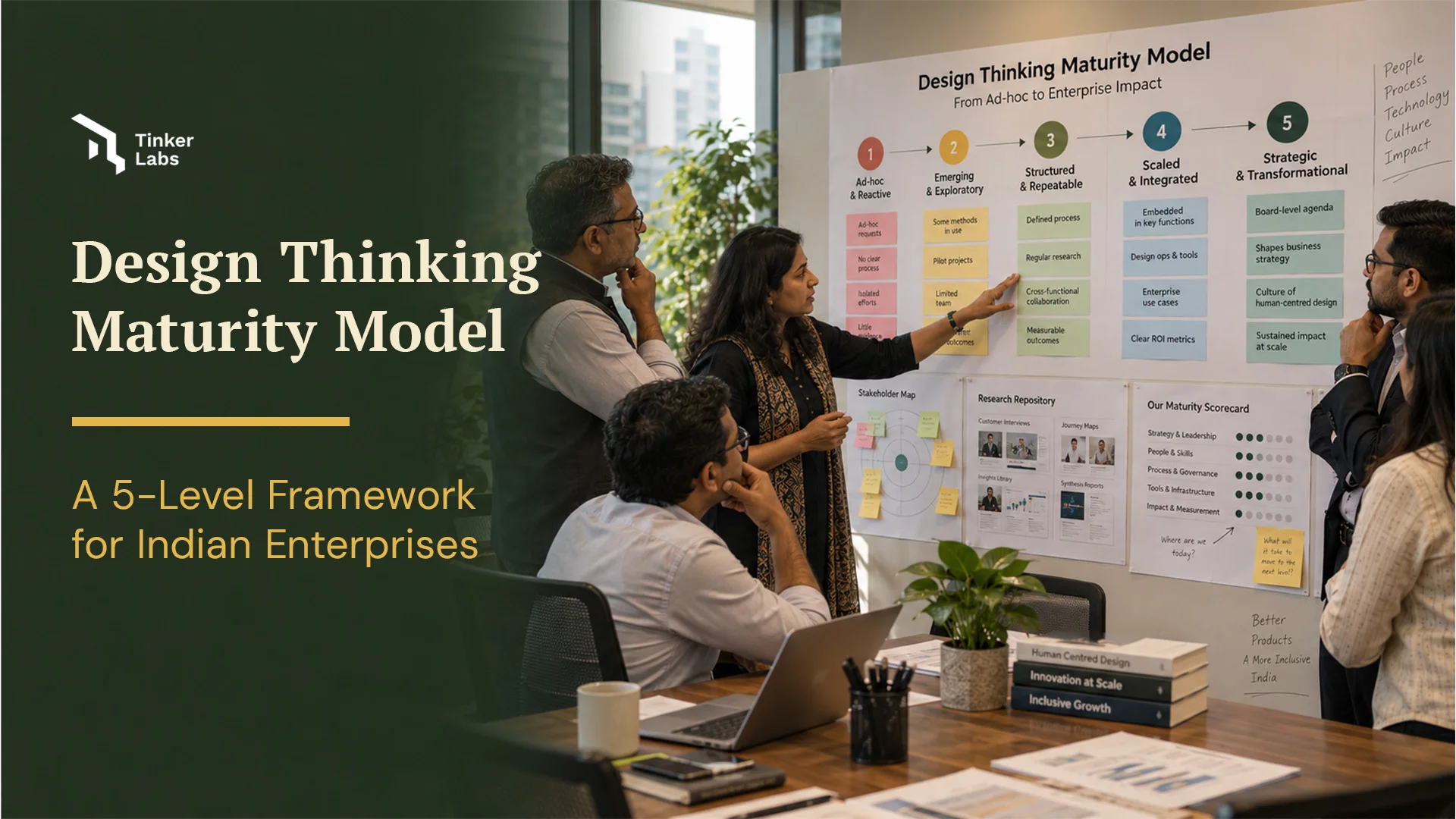
Design Thinking Maturity Model: A 5-Level Framework For Indian Enterprises


Short Description
A design thinking workshop can feel energising without ever changing how a real decision gets made, and most companies rate their own maturity on that feeling rather than on outcomes. This piece offers a five-level model built around Indian organisational realities, from hierarchical, top-down decision-making at one end to design thinking as cultural instinct at the other, and explains why the middle levels are where most enterprises quietly get stuck. It walks through the specific bottlenecks behind that plateau, from delivery-first incentives to a reluctance to challenge senior opinion, and lays out what genuinely moving up a level requires of leadership and budget rather than just training spend.
Blog Summary
Most organisations judge their design thinking maturity by how a workshop felt, but that tells you nothing about whether the practice is actually changing decisions. This piece lays out a five-level maturity model built specifically for Indian enterprises, running from Abhava, where design thinking is absent or purely cosmetic, through to Sanskar, where empathy for the user becomes organisational instinct rather than a process. It names the three bottlenecks that repeatedly stall Indian companies partway up that curve, from delivery-over-discovery culture to hierarchical deference, and explains why self-assessment tends to be either too generous or too averaged to be useful. The framework closes with what actually moving up a level demands leadership, budget, and incentives.
Introduction
Most organisations judge their design thinking maturity by how a workshop felt: good energy, a wall of sticky notes, a satisfied sponsor. None of that tells you whether the practice is actually changing decisions. A design thinking maturity model does: it gives you a structured way to see where your organisation really stands, and a diagnosis you can act on, rather than a score to feel good or bad about.
In India, that diagnosis needs a local lens. Hierarchical decision-making, a fast shift from IT-services delivery to product engineering, and a "jugaad" instinct for quick, frugal fixes all shape how design thinking actually takes root inside a company, or doesn't. The framework below adapts established maturity thinking to that context, across five levels, from ad-hoc absence to design thinking as cultural instinct, essentially turning generic design thinking for enterprises into something built for how Indian organisations actually make decisions.
What A Maturity Model Actually Measures
A maturity model isn't a checklist of design activities completed, it's a way to see whether a practice is embedded in how decisions get made, or just running alongside them. That's a different question from the one a process framework like the Double Diamond answers: the Double Diamond describes how a single project should move from problem to solution, while a maturity model asks whether that way of working has actually taken hold across the organisation.
Two established models are worth knowing before building your own view: the Nielsen Norman Group's framing of UX maturity as a living system that can regress when leadership or budget changes, rather than a ladder that only goes up[1]; and the Danish Design Ladder, which tracks organisations moving from treating design as decoration through to using it as a driver of business strategy[2]. Both point to the same conclusion: most organisations plateau in the middle, and moving further takes a deliberate push, not time served.
That push is worth making. McKinsey's research linking design maturity to financial performance found that the most design-led companies meaningfully outperformed their industry peers[3], evidence that where an organisation sits on a design maturity model isn't an academic question.
A 5-Level Design Thinking Maturity Model For Indian Enterprises
The five levels below adapt that thinking to what we actually see inside Indian enterprises, from services-led organisations still finding their footing with product thinking, to the rare few where design thinking has become instinct rather than initiative.
Level 1 — Abhava (Absence / Ad-Hoc)
Characteristics: Design thinking is absent, or reduced to "making things look nice", a UI layer applied at the end of a project, not a way of deciding what to build.
Indian context: Decisions are strictly top-down, often shaped by the "HiPPO" effect, the Highest Paid Person's Opinion. Customer contact sits entirely with business analysts, leaving engineering and product teams isolated from the people they're building for.
Mindset: "We build what leadership or the client tells us."
Level 2 — Charchā (Awareness & Siloed Action)
Characteristics: The organisation starts building awareness, HR or an innovation cell runs standalone workshops, bootcamps, and certification drives.
Indian context: Call it "post-it note innovation", plenty of employees get certified in design thinking, but return to delivery-focused KPIs that leave no real room for empathy work or problem framing. A one-off design thinking workshop doesn't change that on its own; it needs to connect to how people are actually measured.
Mindset: "We know the theory and have the certificates, but our daily sprints don't change."
Level 3 — Prakriyā (Process Integration)
Characteristics: Design thinking becomes a formal, repeatable method. Cross-functional teams organise around user journeys instead of functional silos.
Indian context: Formal user research gets built in. Cross-functional squads, product, engineering, design, run regular interviews across Tier-1, Tier-2, and rural segments, reflecting how different those markets actually are.
Mindset: "We follow a structured discover-and-solve process for user pain points."
Level 4 — Prayoga (Scientific Experimentation)
Characteristics: Innovation becomes data-driven and hypothesis-led, with dedicated budget for rapid prototyping, continuous testing, and failing fast.
Indian context: Traditional jugaad innovation, reactive, unscalable fixes, gets converted into structured, scalable experimentation. Teams combine quantitative signals (A/B tests, drop-off data) with localised ethnographic research to back decisions.
Mindset: "We don't launch on gut feel; we validate hypotheses with real user evidence."
Level 5 — Sanskār (Cultural Intuition)
Characteristics: Design thinking stops being a conscious "process" and becomes organisational DNA, shaping strategy, HR policy, and long-term planning.
Indian context: Incentives fully align. Leadership backs high-risk, human-centric bets even when they slow short-term delivery, and the organisation acts as a genuine advocate for the Indian consumer rather than chasing competitors.
Mindset: "Empathy for the stakeholder is our default way of thinking and acting."
HHow The Levels Compare Across Four Dimensions
Levels are easier to spot in the specifics than in the labels. Here's how four core dimensions typically show up at each stage:
The Three Bottlenecks That Stall Maturity In India
Across the levels, three specific friction points show up again and again in Indian organisations, and they're worth targeting deliberately, because they rarely resolve on their own.
The "delivery over discovery" trap. A legacy of IT-services culture means teams often over-index on delivery speed and execution efficiency, while badly underinvesting in problem discovery and framing. This discovery vs delivery imbalance is often the single biggest reason a company stalls at Level 2 or 3.
Hierarchical deference. Junior team members and end-users hesitate to challenge assumptions held by senior leaders, which makes honest feedback, internal or external, hard to surface. This is exactly the kind of bias structured behavioural science consulting is built to counter: making the cost of staying quiet, and the value of dissenting evidence, visible to a room instead of leaving it to individual courage.
Incentive misalignment. Engineers get measured on code velocity, product managers on shipping timelines, which quietly punishes anyone who pauses to validate with customers.
How To Find Out Where You Actually Stand
Two mistakes are common when organisations try to self-assess. The first is scoring generously, everyone rates their own practice higher than an outsider would. The second is averaging: a team that's strong on process but weak on measurable outcomes doesn't average out to "middle of the pack", it's a specific, fixable problem that an average conceals. Score honestly against evidence you could point to, not intention, and act on your weakest dimension, not your overall total.
It also helps to remember maturity isn't a ladder you climb once. As NN/g frames it, maturity is a living system[1], a reorganisation, a leadership change, or a tight quarter can cost an organisation a level it thought it had already earned. Treat the assessment as something you repeat, not a badge you collect.
Getting an honest read is often easier with an outside view, which is where structured design thinking consulting earns its keep. An outside team isn't invested in your organisation's internal politics, which tends to make the diagnosis more honest.
What Moving Up A Level Actually Requires
- Protecting time and budget for discovery, so it isn't the first thing cut when delivery gets busy
- Attaching every workshop or research sprint to a named decision-owner and a real deadline, not just a summary deck
- Building a second facilitator, so capability doesn't rest on one person's calendar
- Tying at least one leadership incentive to evidence-based outcomes instead of activity, ideas tested, not workshops run
Conclusion
A design thinking maturity model isn't about the label your organisation gets, it's about knowing precisely which lever to pull next: better research, sharper problem framing, tighter feedback loops, or a shift in who gets rewarded for what. For Indian enterprises moving from Abhava to Sanskar, that shift rarely happens on its own. It takes structural changes to who's in the room, what gets measured, and how much safety people feel challenging the loudest voice.
References
- Nielsen Norman Group. UX Maturity: A Living System, Not a Ladder. (Accessed on sept 2026). Available from: https://www.nngroup.com/articles/ux-maturity-living-system/.
- Danish Design Centre. Design Delivers: How Design Accelerates Your Business (the Design Ladder). (Accessed on sept 2026). Available from: https://ddc.dk/wp-content/uploads/2021/09/Design-Delivers-How-design-accelerates-your-business.pdf.
- McKinsey & Company. The Business Value of Design. (Accessed on sept 2026). Available from: https://www.mckinsey.com/capabilities/tech-and-ai/our-insights/the-business-value-of-design.
Find Out Where Your Organisation Stands
TinkerLabs works with Indian enterprises at every stage of this maturity curve, from an organisation's first structured workshop to embedding evidence-based decision-making as its default. If you'd like an outside read on where your organisation stands, let's talk.
About the Author

Mandeep Toor
Head of Trainings & Workshops at TinkerLabs
Mandeep helps organisations build innovation capability through design thinking and behavioural science. With over a decade in innovation and entrepreneurship, he has led 75+ workshops for leaders at firms like Piramal Group, Samsung, Flipkart, HP, and Hindustan Unilever, and teaches Design Thinking at IIMs, MICA, and SOIL Institute of Management. Know more →

