


In software, what’s innovation vs invention vs improvement—and how should product teams prioritize them on the roadmap?


Almost every software project ships regularly. But not all projects are equal — some improve an existing product, some change industries, and some create something entirely new. To build a winning roadmap, you must first understand which direction each project is heading.
Every planning cycle forces hard choices. Engineering pushes to pay back technical debt, sales pushes for a promised integration, and the CEO pushes for the AI feature. The trouble starts when teams treat all roadmap work the same way — because invention, innovation, and improvement carry very different risk, cost, and timelines.
Invention vs Innovation vs Improvement, Defined
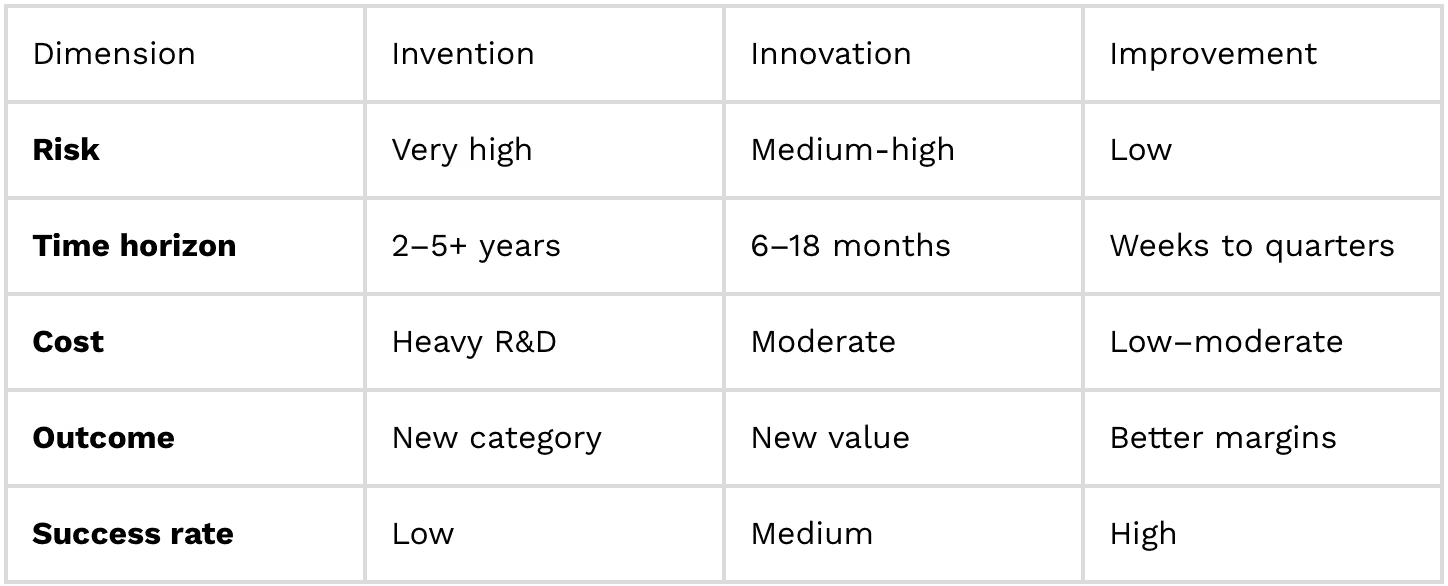
Invention is rare. Very few feature-level inventions are made; most happen at the platform level. The transformer architecture behind today's LLMs, the React virtual DOM, Kubernetes, and AWS S3's first object storage model are all invention — each took years of R&D before earning money. For how readiness is judged beyond software, see our R&D and TRL framework guide.
Innovation uses existing technology to produce value or profit. ASQ defines it that way.[1] In SaaS, Notion combined a wiki, docs, and database into one tool; Linear reimagined issue tracking around speed.
Improvement makes what you have faster, cheaper, or easier to use — cutting API latency, smoothing onboarding, fixing slow pages. Small gains that compound to big results.[2]
How They Show Up on a Product Roadmap
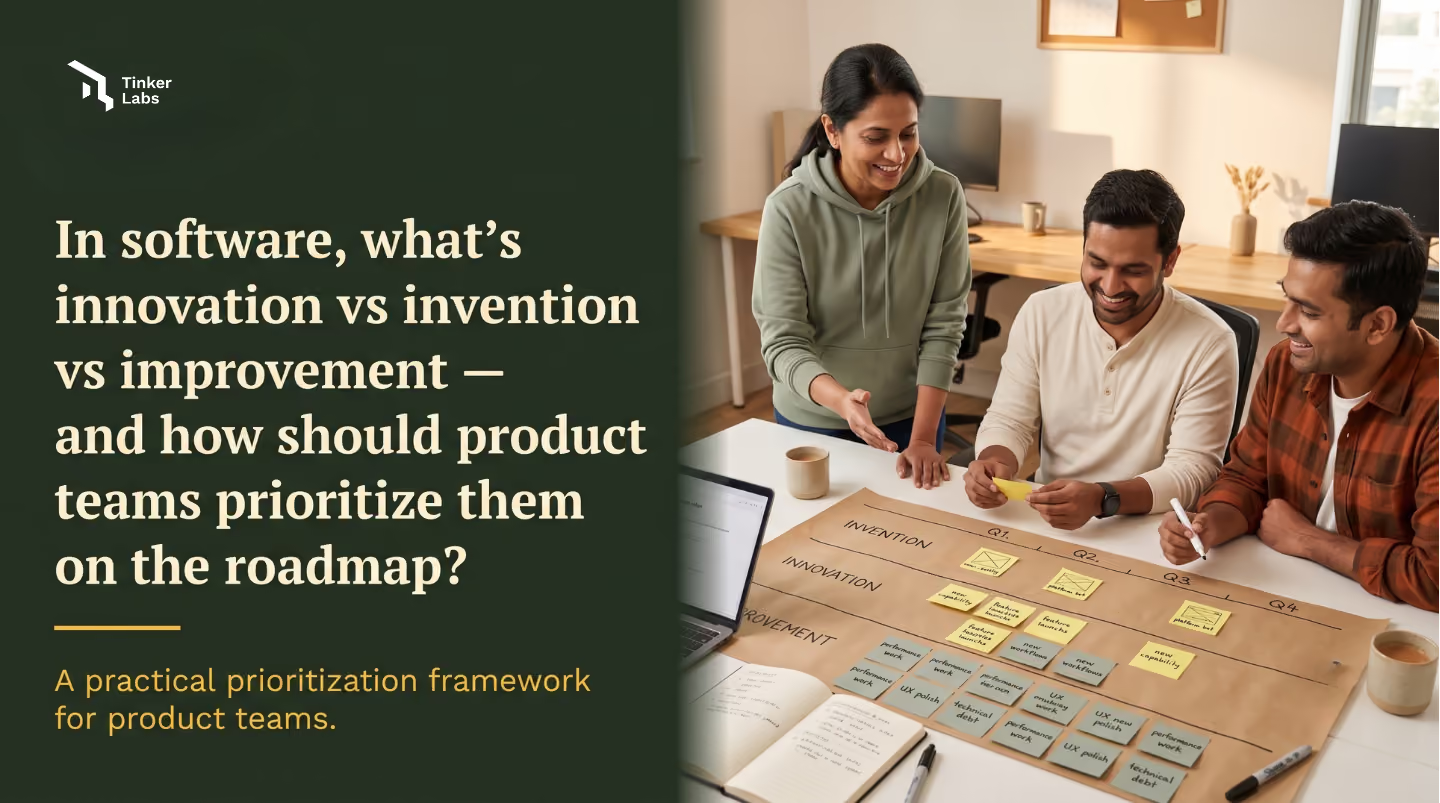
Invention-led items are big bets on future functionality, tested with a prototype — a 2–4 quarter project with uncertain outcomes. Innovation-led items turn existing technology into new value: a new workflow, a new user type, a new price point. Most "big feature" headlines fall here. Improvement-led items — performance, UX, reliability, technical debt — are best handled as ongoing backlogs or capacity splits, not individual feature requests.
When to Choose Invention, Innovation, or Improvement
Pre-PMF, improvement is a waste of time. Focus on what customers want — that's innovation — and save invention for problems current technology can't solve. At scale, improvement matters as much as invention did early on; without it, each cycle takes longer to reach the next peak.[3] See the engineering-driven view of the product lifecycle for more.
Platform products that act as application marketplaces must invent new pieces for other engineers to build on. And in competitive markets, innovation creates another round of differentiation — lean only on improvement and you slowly get treated like a commodity.[4]
The Cost of Getting It Wrong
When 80%+ of the roadmap is improvement, retention holds but growth stalls — you're suiting current customers instead of unlocking new ones. Chase invention too early, before funding, customers, and proof points, and you'll run out of runway first. And shipping more features isn't innovating more: if they don't drive acquisition, retention, expansion, or unit economics, they're just improvement work in disguise.
A Prioritization Framework for Software Teams
Rate each roadmap item on Risk (1–5), Reach (users affected), and Reversibility. High-reach, easy-to-reverse items test quickly; high-risk, hard-to-reverse items need R&D-grade scrutiny via Technology Readiness Levels. A practical starting allocation:
- Pre-PMF: 70% innovation · 20% invention · 10% improvement
- Post-PMF growth: 60% innovation · 30% improvement · 10% invention
- Mature scale: 40% improvement · 40% innovation · 20% invention
Tie every item to a measurable customer outcome — a practice recommended by Aha![5] — and cap ~20% of engineering capacity each quarter for platform health. It's the lowest-cost insurance you can buy.
Common Mistakes Product Leaders Make
"Innovation labs" create demos, not products — real innovation is a leadership decision about how to spend time, not a side effort in a sandbox. And ignoring improvement has a delayed cost: skip it long enough and you get "2 Year Shippers," teams whose neglected work explodes into a six-month rebuild.
Strong teams avoid both traps. They do all three — invent, innovate, improve — but not in equal measure, planning the mix against strategic goals and revising it every two quarters.
Conclusion
Software innovation vs improvement isn't a yes-or-no answer. It's a balance of invention, innovation, and improvement for your stage, customers, and goals — reviewed regularly. The same balance shows up in Banking and E-Commerce too.
CTA: Apply This Framework to Your Product Roadmap Today
We use design thinking for business innovation to help teams build roadmaps that move the business. Let's chat.
About the Author

Mandeep Toor
Head of Trainings & Workshops at Tinker Labs
Mandeep helps organisations build innovation capability through design thinking and behavioural science. With over a decade in innovation and entrepreneurship, he has led 75+ workshops for leaders at firms like Piramal Group, Samsung, Flipkart, HP, and Hindustan Unilever, and teaches Design Thinking at IIMs, MICA, and SOIL Institute of Management. Know more →
References
- What Is Innovation? ASQ Quality Resources. Available from: https://asq.org/quality-resources/innovation. Accessed Apr 2026.
- KaiNexus. Innovation vs. Improvement: What's the Difference? KaiNexus Continuous Improvement Resources. Available at: https://www.kainexus.com/continuous-improvement/innovation-vs-improvement.
- Equiliem. Innovation vs. Continuous Improvement. Equiliem Blog. Available from: https://www.equiliem.com/blog/innovation-vs-continuous-improvement.
- Qmarkets. Improvement vs Innovation: Which Is Better for Your Business? Qmarkets Resources. Available from: https://www.qmarkets.net/resources/article/improvement-vs-innovation-which-is-better-for-your-business.
- Aha! Labs. Innovation Roadmap: A Guide for Product Teams. Aha! Roadmapping Guide. Available from: https://www.aha.io/roadmapping/guide/roadmap/innovation-roadmap.

