


Design Thinking Process for Enterprises: Discovery to Scale


When we talk about the design thinking process, people often think of workshops, sticky notes, and coming up with ideas quickly. But that's just the surface level. In a big company, the real benefit of design thinking comes when it's used as a regular way of working, to help teams come up with new ideas. It should help them understand the problem they're trying to solve, test their ideas with real people, learn from what works and what doesn't, and decide which ideas are worth trying out on a bigger scale. This way, design thinking becomes a powerful tool for innovation, helping teams to create solutions that really work for users. By using design thinking as a repeatable process, companies can make sure they're always coming up with new and better ideas, and that they're testing and learning from them in a way that's fast and effective.
In real life, this means going beyond just a one-day workshop and creating a clear path that takes you from finding out what you need to do, to defining what that is, to developing a plan, testing it, and then making it bigger. The best companies use this process to make sure everyone is on the same page - from the business side to the design team, the tech people, and the operations crew - instead of just leaving things to happen by chance.
What the design thinking process means in an enterprise setting
At a basic level, the design thinking process is a human-centred way to solve complex problems. IDEO describes design thinking as a human-centred approach to innovation,[4][5] while the Design Council's Double Diamond model organises the work into divergent and convergent phases: discovering and defining the right problem, then developing and delivering the solution.[1][2]
For a big company, the process is not just about being creative, but about making smart decisions. It helps leaders make sure they're solving the right problem, because if they're not, their big projects can get stuck after the initial excitement wears off. This way, they can avoid wasting time and resources on something that won't work. By being disciplined and methodical, leaders can make better choices and get the results they want.
So what's the big change here? It's when teams stop asking "Which idea seems cool?" and start asking "What proof do we need before we invest time and money?" This small tweak really helps teams stay focused, avoid doing the same work twice, and makes it easier to get things done. It's all about making sure we have the right information before we commit to something.
Why enterprises need a process, not just a workshop
A workshop creates energy. A process creates movement. Enterprises usually need both, but they should not confuse one for the other. A good workshop can surface needs, tensions, and ideas. A good process translates those inputs into decisions, experiments, and ownership.
When teams don't have a clear process, they usually end up with a lot of ideas written on the wall, but no idea what to do next. But with a good process, they can leave with a clear understanding of the problem they're trying to solve, a hypothesis they can test, someone in charge of making decisions, and a plan for how to move forward with a pilot program. This way, everyone is on the same page and knows what needs to happen next.
This is really important, especially in big companies where lots of different teams have to work together and agree on things like risk, budget, and how it will affect customers. In these situations, having good governance isn't about creating red tape, it's actually what helps make sure that trying new things is both useful and safe.
A practical enterprise design thinking process: discovery to scale
1. Discover: understand the real problem
The first part of design thinking is all about finding out what's going on. We call this discovery. The main goal here is to get a clear picture of the people using something, the limitations they face, what motivates them, and how they behave now. To do this, we usually talk to people, watch how they do things, map out their experiences, look at data, and have conversations with people involved in the process.
In enterprise work, discovery should never be treated as a nice-to-have research phase. It is the point where teams uncover hidden friction, process bottlenecks, compliance constraints, and the causes of poor adoption.
Useful outputs at this stage include a problem landscape, user needs summary, stakeholder map, and a shortlist of opportunities that are worth exploring further.
2. Define: frame the opportunity clearly
The define stage turns observations into a precise challenge. This is where strong problem framing pays off. Instead of writing a vague brief such as "improve customer experience", teams should describe who is struggling, what is happening, why it matters, and how success will be measured.
A good definition prevents a lot of waste later. It also makes it easier to get stakeholder alignment because the team is debating the same problem, not four different interpretations of it.
Practical deliverables include a "How might we" statement, success metrics, assumptions list, and a decision on which concept is worth moving into a sprint cycle.
3. Develop: generate and shape solutions
This is where ideas start to take shape and prototypes are built. The goal isn't to get everything just right, but to come up with several good options and see how they stack up in terms of value, feasibility, and the work involved. It's about exploring different paths and comparing them to find the best way forward.
Good teams know how to balance two ways of thinking. First, they think broadly and come up with lots of ideas. Then, they narrow it down and pick the best ones based on facts, how it fits with their goals, and what's actually possible. The Design Thinking Bootleg from Stanford d.school is a great resource for this. It has a bunch of methods that can help teams do this effectively.
In a big company setting, you don't need a perfect prototype to find the big problems. A simple mock-up of a journey, a blueprint of a service, a clickable flow of screens, or even just acting out a new process can be enough to show what might go wrong. This can help you catch the major risks early on and make changes before things get too complicated.
4. Pilot: test in a controlled environment
This is where ideas are put to the test. When you're running a pilot program, it's essential to keep it small and manageable, but also big enough to give you some real insights. The goal is to learn from how people actually behave, rather than just relying on what you think might happen. By doing it this way, you can get a sense of what works and what doesn't, and make adjustments accordingly. It's all about being open to learning and using that knowledge to make informed decisions.
A strong pilot plan includes the user segment, scope, timeline, owner, measurement method, and escalation route. It also defines what counts as success, what counts as a warning sign, and what would cause the team to stop or revise the concept.
This is also where testing becomes critical. Teams should observe adoption friction, turnaround time, error rates, complaints, conversion, or any other metric that reflects the business problem they are trying to solve.
5. Scale: turn learning into repeatable change
Scaling does not mean copying the pilot everywhere overnight. It means preparing the organisation to adopt the solution with the right training, systems, standards, support, and ownership.
This is where the implementation roadmap matters. Leaders should decide what must change in policy, technology, service design, communications, and capability building before expanding the solution.
When design thinking is done really well, it's not just about coming up with one great idea. It actually changes the way the whole company works. They make better decisions, learn more from the people who use their products, and get different teams working together more smoothly. This helps them make lots of good changes, not just one.
What to measure at each stage
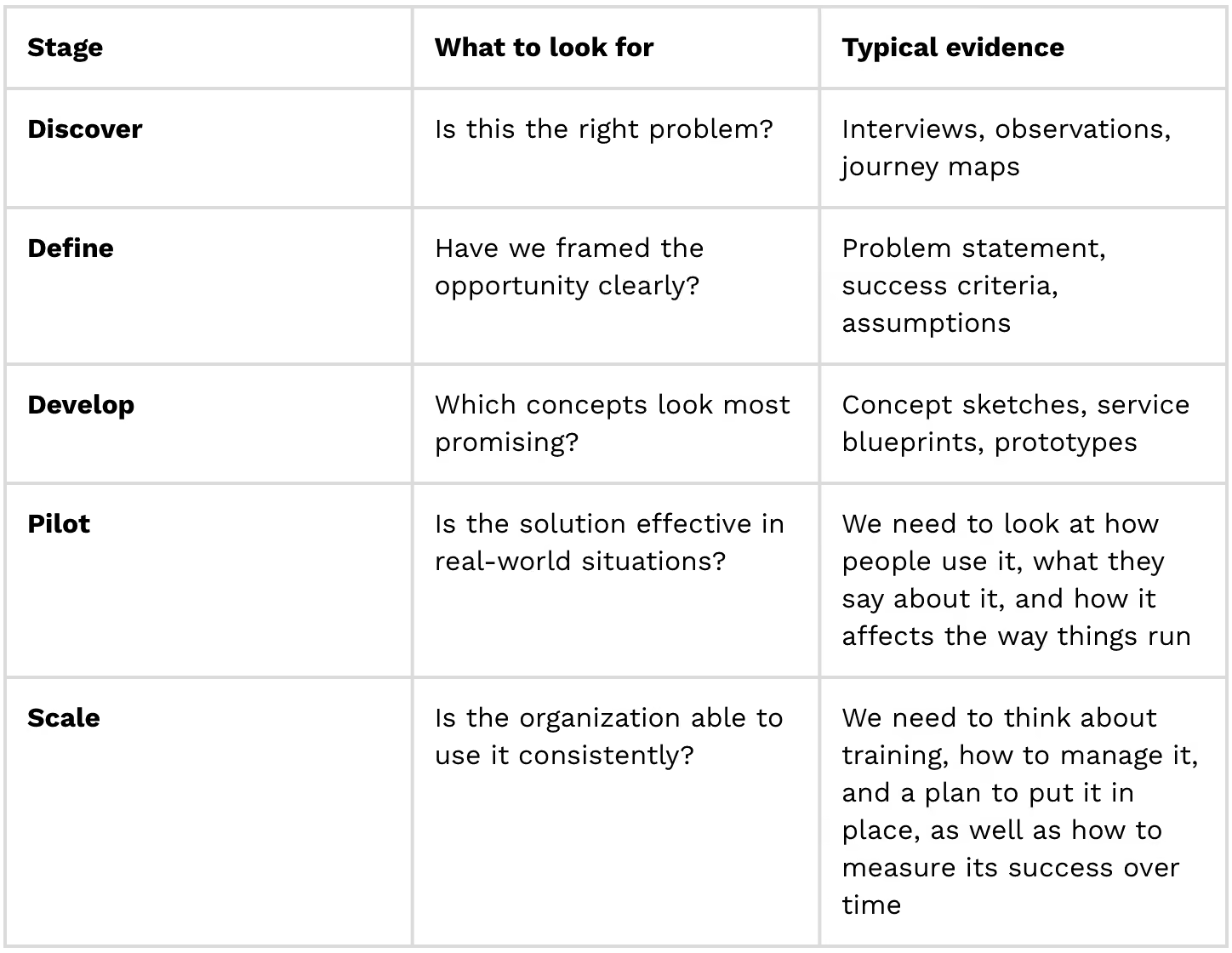
How to run the process with the right people
To get the best results, you need a team with different skills and views. This team should have a person who supports the project, someone to lead the team, a person to do research, the owner of the product or service, someone from operations, a technology expert, and someone who knows what the customer wants. Having all these people work together helps you understand the problem and find a solution that works for everyone.
The sponsor protects time and budget. The facilitator keeps the conversation structured. The product or service owner ensures decisions turn into action. Operations and technology help the team stay honest about feasibility and delivery.
When it comes to innovation in big companies, getting things to work together is really important. This is because most new ideas don't fail because they're not good enough, but because they don't get passed on properly, or it's not clear who's in charge, or they don't get the support they need to actually make a difference.
One practical rhythm is simple: discover in week one or two, define in week three, develop concepts in week four, run a pilot in the following weeks, and review the evidence in a formal governance checkpoint. The timing can change, but the logic should remain stable.
Common mistakes that weaken enterprise outcomes
- Starting with a solution instead of a problem.
- Treating a workshop as the finish line.
- Ignoring what users say and just going with what you think.
- Running a pilot without clear success metrics.
- Not thinking about how to make changes work after the idea is accepted.
- Scaling too early before the operating model is ready.
One big problem is making the process too complicated. We don't need to write down everything. What we need is a simple plan that helps us make good decisions and the freedom to learn from our mistakes.
Example: a realistic enterprise rollout in India
Imagine a mid-sized Indian financial services company trying to reduce drop-offs in a digital onboarding journey. The team starts with discovery, speaking to customers, agents, compliance staff, and call centre teams. They discover that most drop-offs are not caused by lack of interest, but by confusing document requests and unclear status updates.
In the define stage, they frame the issue around "helping first-time applicants complete onboarding with less friction". In develop, they create a few low-fidelity service concepts, including a simpler document checklist and a proactive status update flow. In the pilot program, they test the ideas in one region before expanding.
So, if the pilot is a success, with more people finishing the program, fewer calls to the support team, and less rework needed, then the team can start making a plan to roll it out to more people. This plan would include things like training sessions, updates to the system, and new templates for talking to customers.
Conclusion
A good design thinking process helps companies stay on track as they go from exploring ideas to testing and finally putting them into action. It combines understanding people's needs, defining problems, creating prototypes, testing them, and making sure everything runs smoothly into one organized system. This way, businesses can keep moving forward without losing steam or forgetting to be responsible.
When done right, it can really speed up the learning process, get everyone on the same page, and make new ideas more believable. But what's even more important is that it helps companies take good ideas and turn them into smart decisions that actually lead to real change.
Bring this process into your enterprise
Tinker Labs works with leaders in India to help them solve problems using a special approach called design thinking. This approach helps teams understand problems, come up with ideas, test them, and make them work on a big scale. We do this by providing expert guidance through our design thinking consulting services, which can turn unclear ideas into real, measurable changes. If you're interested in trying out this approach for your next project, let's talk about how we can help you get started and make your ideas a reality.
About the Author

Mandeep Toor
Head of Trainings & Workshops at TinkerLabs
Mandeep helps organisations build innovation capability through design thinking and behavioural science. With over a decade in innovation and entrepreneurship, he has led 75+ workshops for leaders at firms like Piramal Group, Samsung, Flipkart, HP, and Hindustan Unilever, and teaches Design Thinking at IIMs, MICA, and SOIL Institute of Management. Know more →
References
- Design Council. The Double Diamond. Available from: https://www.designcouncil.org.uk/our-resources/the-double-diamond/.
- Design Council. Framework for Innovation. Available from: https://www.designcouncil.org.uk/our-resources/framework-for-innovation/.
- Stanford d.school. Design Thinking Bootleg. Available from: https://dschool.stanford.edu/tools/design-thinking-bootleg.
- IDEO. Design Thinking. Available from: https://designthinking.ideo.com/.
- IDEO. Human-Centered Design FAQ: What's the difference between human-centered design and design thinking?Available from: https://designthinking.ideo.com/faq/whats-the-difference-between-human-centered-design-and-design-thinking.
- OECD. Governance of Innovation Systems. Available from: https://www.oecd.org/content/dam/oecd/en/publications/reports/2005/08/governance-of-innovation-systems_g1gh5aee/9789264011038-en.pdf.

