


Design Thinking Workshop Cost In India: What Corporates & Institutes Should Actually Budget For


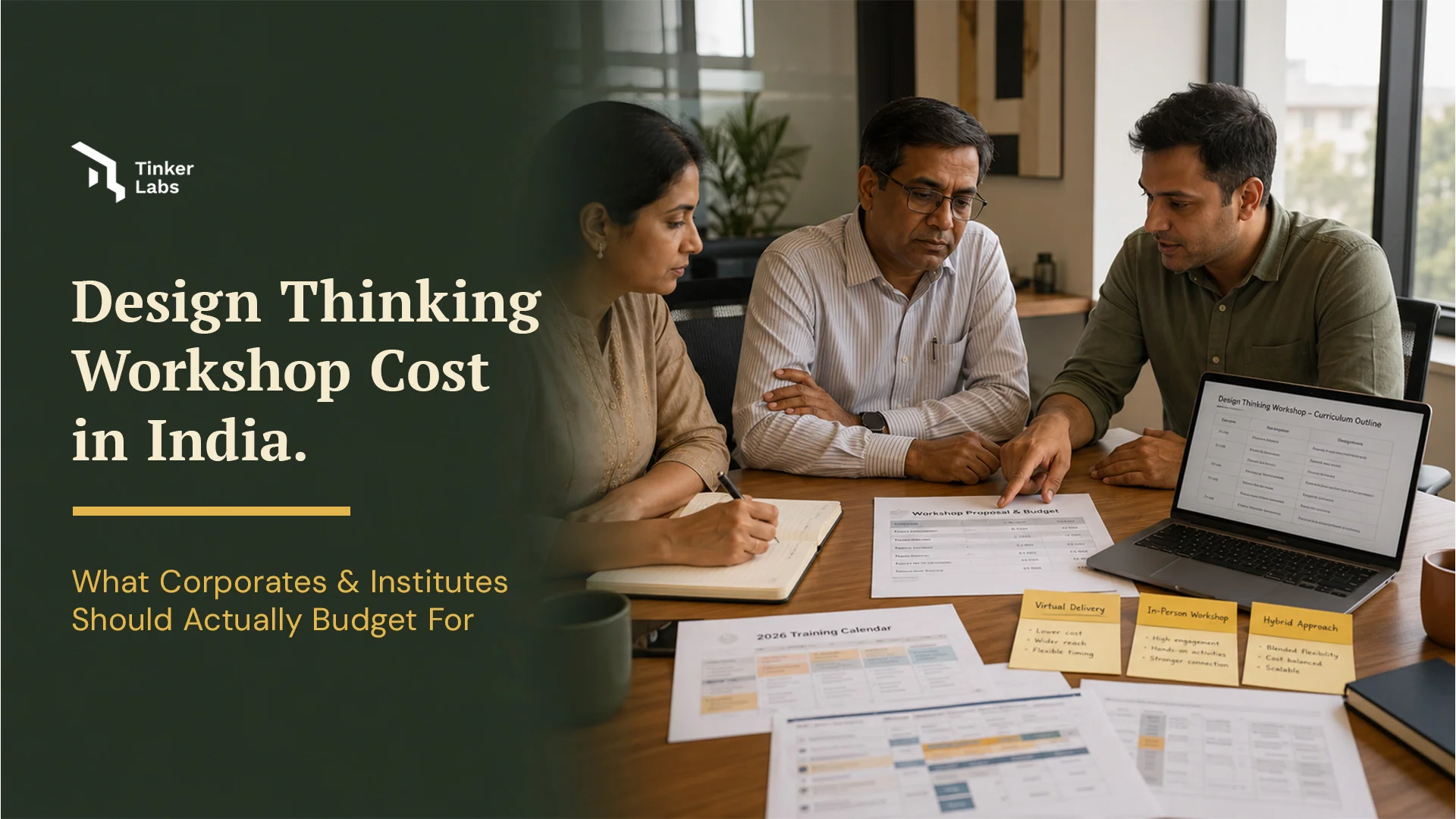
Short Description
Design thinking workshop in India has its cost ranging from a few thousand rupees to several lakhs, depending on format, duration, group size, customization, and facilitator expertise. This guide breaks down exactly what drives pricing so corporate L&D teams and university training heads can budget accurately. Skip the guesswork of published price lists and understand what you're really paying for before you request a quote.
Quick Summary
Design thinking workshop cost in India vary widely, from a few thousand rupees for a self-paced online module to several lakhs for a fully customized, multi-day corporate immersion. The real price comes down to five factors: format (online vs in-person), duration, group size, degree of customization, and facilitator expertise. Rather than quoting a single number, this guide breaks down what actually drives the cost so corporate L&D teams and university training heads can budget accurately, and shows why a tailored quote is more useful than any published price list.
Introduction
Search for "design thinking workshop cost in India," and you've probably noticed the numbers online swing wildly, anywhere from a few thousand rupees to well over a lakh per participant. That's not inconsistency, it's simply the nature of the offering. A design thinking workshop isn't a fixed product like a textbook or a software license. It's a facilitated learning experience, and its price gets shaped by exactly what you need it to do for your team.
For HR and L&D leaders at corporates, and training heads at universities and institutes, the more useful question isn't "what's the price," it's "what am I actually paying for, and what should I budget for our specific goals." This guide walks through the real cost drivers behind design thinking training India providers actually charge for, what a typical fee includes, and how to plan a budget that won't leave you either overpaying or underprepared.
The Real Factors That Drive Design Thinking Workshop Pricing
Format: Self-Paced, Live Virtual, Or In-Person Immersion
Self-paced online modules sit at the most accessible end of pricing. They use pre-recorded content and are the lowest touch option, suitable for individual awareness building but not real skill application. Live virtual workshops are the most expensive option, as it involves real facilitators, live breakout exercises and real interaction. It is the middle tier for most professional bootcamps. In-person immersions, especially residential ones run by premium business institutes, sit at the top of the range because they combine facilitator time, venue costs, printed toolkits, and multi-day engagement all at once.
Duration: A Half-Day Primer Vs A Multi-Day Deep Dive
A two-hour primer session and a three-day applied workshop are fundamentally different investments, not just in facilitator hours, but in how much depth participants actually walk away retaining. Short sessions build awareness. Longer, project-based formats build capability. Workshop duration is one of the single biggest levers on price, and it should map directly to the outcome you're actually solving for.
Audience Size: Individual Enrollment Vs Corporate Cohort
Individual enrollment into an open-batch program is typically priced per seat. Corporate training, by contrast, is almost always quoted per cohort or per day rather than per head, so a 15 to 20 person in-house workshop gets priced as one engagement, not 20 separate tickets. This distinction alone explains a lot of the pricing confusion people run into when comparing individual course fees against cohort-based training quotes for a corporate design thinking workshop.
Customization: Off-The-Shelf Curriculum Vs A Bespoke Business Challenge
A generic curriculum covering standard design thinking frameworks costs less to deliver than a workshop built around your organization's actual business problem, one using your real customer data, your product challenges, and a capstone tied to your roadmap. Customization requires more pre-work from the facilitator and typically carries a premium, but it's also what makes the learning stick and translate into actual business outcomes. This is where custom corporate training earns its higher price tag.
Facilitator Expertise & Institutional Credibility
A workshop led by a practitioner with deep, applied design thinking experience, or one backed by an established consultancy, will price differently from a freelance trainer or a generic vendor. This isn't just about status. Facilitator quality directly affects how well ambiguous, real-world problems get handled in the room, which is a large part of what corporates are actually paying for. It's also a key consideration during training vendor selection.
Corporate Training Vs Individual Certification: Two Different Cost Conversations
Worth separating these two buying motions clearly, since they often get compared as though they're the same thing.
Individual certification is usually chosen by a single professional investing in their own upskilling, priced per person, with the buyer optimizing for a design thinking certification plus practical exposure.
Corporate group training gets chosen by an organization solving a specific capability gap across a team or department, priced per engagement, with the buyer optimizing for business outcomes, culture change, or a live project deliverable, not just a certificate.
If you're an L&D lead comparing quotes, make sure you're comparing like for like. A per-seat certificate program and a customized, in-house cohort workshop aren't interchangeable line items on your L&D budget.
What's Usually Included In The Fee
Regardless of format, most credible design thinking workshop providers structure their fee around three components:
- Learning resources such as digital toolkits, framework templates, and reference material participants can revisit after the session.
- A capstone or applied project like a guided exercise or simulation tied to a real business challenge, not just theory.
- Certification which includes recognition that's either globally accepted or acknowledged by relevant domestic industry bodies, useful for both individual CVs and corporate compliance records.
Understanding what's bundled into the fee, versus what's charged separately such as venue, travel, or printed kits, often matters more than the headline number itself.
How Corporates And Universities Can Budget Smartly
Rather than anchoring to a single published price, build your budget around three inputs:
- Outcome first. Decide whether you need awareness, applied skill-building, or a business-outcome-linked engagement, perhaps even an executive immersion program. This alone narrows down the format and duration.
- Audience size and mode. Confirm whether you're training individuals or a cohort, and whether virtual or in-person suits your team's schedule and geography.
- Curriculum depth. Decide upfront how much customization to your actual business context you need. Generic frameworks cost less, tailored capstones cost more but deliver more.
Map these three inputs before requesting quotes, and you'll get significantly more accurate, and comparable, pricing from any provider you approach.
Why A Custom Quote Beats Any Published Price List
Design thinking workshop costs in India are subject to change based on workshop curriculum, delivery mode, group size, and the level of customization you need, which is exactly why a fixed price list rarely reflects what you'll actually pay. The best way to budget is to share your specific goals, team size and timeline with a provider and have a proposal built around your context.
Tinkerlabs works with corporates and educational institutions across India to design design thinking workshop in India and training engagements around real business and learning outcomes, rather than one-size-fits-all pricing. If you're evaluating a design thinking course India for your team, connecting directly with a leading design thinking company in India for a tailored quote will save you more time, and budget, than comparing published numbers across websites.
Conclusion
There's no single honest answer to "how much does a design thinking workshop cost in India," and any provider who gives you one number without understanding your goals is likely oversimplifying things. The real cost gets shaped by format, duration, group size, customization, and facilitator expertise.
Once you're clear on what outcome you need, a specific, comparable quote becomes easy to get, and far more useful than a generic price range. For organizations exploring a serious design thinking consulting engagement or a structured workshop program, talking to a specialist remains the fastest way to a number you can actually plan around.
Frequently Asked Questions
1. Is Design Thinking Still Relevant In 2026/2027?
Yes, arguably more than ever. As more businesses adopt AI-based tools and automation, the skill of framing ambiguous problems, understanding real user needs and quickly prototyping solutions is a distinctly human skill that design thinking directly builds.
2. Is A Design Thinking Course Or Workshop Available In India?
Yes. India offers a large menu of options from self-paced online certificates and professional-body bootcamps to premium institute programs and bespoke corporate workshops delivered by specialist consultancies.
3. How Long Does A Typical Design Thinking Workshop Run?
An intro session could be a few hours, but an applied, project-based immersion could be a few days. The length of time you need depends on whether you are looking for awareness or measurable skill application.
4. Should We Choose A Short Primer Or A Longer Immersion Program?
If your team needs foundational exposure to the mindset and vocabulary, a shorter session works well. If you need your team to walk away having applied the method to a real business challenge, a longer, project-based format delivers significantly more value.
About the Author

Mandeep Toor
Head of Trainings & Workshops at TinkerLabs
Mandeep helps organisations build innovation capability through design thinking and behavioural science. With over a decade in innovation and entrepreneurship, he has led 75+ workshops for leaders at firms like Piramal Group, Samsung, Flipkart, HP, and Hindustan Unilever, and teaches Design Thinking at IIMs, MICA, and SOIL Institute of Management. Know more →
References
- HCD Institute. Design Thinking Courses in India: The Complete 2026 Guide (Certifications, Fees & Formats). [Internet] (Accessed Aug 2026). Available from: https://hcd.institute/article/design-thinking-courses-in-india.
Disclaimer
This article is intended for general informational and educational purposes only and does not constitute financial, legal, regulatory, or investment advice. It is not a recommendation to adopt any specific product, pricing model, or technology solution. Statistics and examples are drawn from third-party industry sources current as of publication and may not reflect the latest regulatory requirements in every market; readers should consult qualified legal, compliance, and financial professionals before implementing personalization strategies involving customer data, credit decisions, or regulated financial products. Results from AI-driven personalization will vary by institution, market, and implementation, and no specific outcome is guaranteed. Brand and company names referenced are used for illustrative purposes only and do not imply endorsement or partnership.

