


Design Thinking Consulting For Business Transformation In India


Short Description
Real design thinking consulting is a structured way to get siloed teams aligned around the right problem before they commit to a solution. This guide covers what a credible engagement actually involves: problem framing, cross-functional workshops, low-fidelity prototyping, and measurable outcomes tied to leadership KPIs plus the India-specific challenges (hyper-localised UX, offline-to-online workflows, frugal innovation) a good partner needs to design for. It closes with a checklist for evaluating consulting partners and separating genuine capability-building from sticky-note theatre.
Blog Summary
Most design thinking consulting is a workshop deck rebranded as innovation. This piece explains what a genuine engagement looks like instead, one that starts by framing the right problem, builds alignment through workshops that end in decisions rather than more discussion, and tests ideas cheaply before an organisation commits real money to them.
It also lays out what makes the Indian market distinct, from hyper-localised UX to offline-to-online workflows, and gives leadership teams a checklist for telling a real innovation partner apart from one just selling sticky notes.
Introduction
For clients looking for design thinking consulting services, it is essential to remember that a good service is not merely a workshop deck repackaged and rebranded into an 'innovation' package.
The person leading the work needs a pragmatic understanding of how to reduce confusion and get various teams and stakeholders to work as a single unit toward resolving customer and business problems. Most organisations in India, from large, mature corporations to family-owned businesses in transition, to growth-stage companies are trying to innovate and scale sustainably. They need a human-centred, pragmatic approach to design thinking that is strongly connected to their commercial goals.
This blog explains design thinking as a route to business transformation, what a design thinking consulting project looks like, and how to choose the right partner for your innovation work.
For organisations weighing design thinking consulting and strategy facilitation as a genuine capability rather than a one-off workshop, the sections below break down what a credible engagement actually involves, and what India's market demands from it.
Why Design Thinking Consulting Matters In India
Innovation in Indian corporations is typically of the 'run' variety which includes scaling fast across a large, complex mix of physical and digital touchpoints. Large teams operate in silos, weighed down by legacy systems and strict compliance requirements, even as customer expectations keep rising. What these organisations need from innovation consulting isn't another round of creativity workshops, but a human-centred approach to problem-solving that helps them choose the right problems, test solutions quickly, and align stakeholders around evidence.
Design thinking has become the preferred route because it is fundamentally user-focused basically centred on human needs.[1][2] When an organisation adopts it for business innovation, it becomes more user-focused as a whole: leaders stop guessing at what customers need and start understanding customer behaviour and the frictions people actually experience and where those frictions can be designed away.
Every industry carries its own innovation challenges. In healthcare, retail, education, banking and financial services, manufacturing, and IT services, businesses are working to improve the customer experience they deliver. Most already have strong products and services; what lets them down is an experience that feels inconsistent, slow, or hard to scale. Design thinking helps organisations spot these experience gaps and close them through changes in business practice and process.
India's market adds a further layer of complexity that a good design thinking consulting partner needs to design for:
- Hyper-localised UX: building for low-literacy users through voice-first interfaces, local languages, and visual iconography rather than a one-size-fits-all interface.
- Offline-to-online workflows: blending the trust of traditional, in-person retail with the convenience of modern digital payments and delivery.
- Frugal innovation: stripping over-engineered global products down to what genuinely delivers value at accessible price points, without cutting quality.
This is also why design thinking consulting has moved from a nice-to-have into a boardroom priority: more large enterprises are now embedding design thinking specialists inside core strategy functions, not just innovation labs, to build customer empathy into everyday decision-making rather than treating it as a once-a-year workshop exercise.
What Design Thinking Consulting Actually Does
Design thinking is a structured problem-solving methodology that combines research, workshop facilitation, prototyping, and decision support, helping an organisation choose between alternatives, and choose faster. It is, at its core, a form of human-centered design, prioritising real user behaviour over internal assumptions. The framework flexes across settings. At a large multinational like IBM, for instance, it has been adapted into an enterprise model of how teams work together: rather than a small workshop of designers and engineers solving one design problem, the enterprise model focuses on getting every team working on a problem oriented to the same outcome for users.
Some large technology and process-consulting firms compress this into a simple three-stage arc: examine the problem in depth, explore multiple directions through rapid prototyping, then execute the validated solution. The labels vary from firm to firm, but the underlying discipline of moving from diagnosis to divergence to a scaled decision is consistent across most credible design thinking practices.
A good design thinking consulting firm helps clients clarify problems and build cross-functional agreement on what will work for users and for the organisation. That means running low-risk experiments to test solutions before committing to scale, which in turn calls for real skill in strategy facilitation. The best workshops aren't a series of discussions with no follow-through; they are a structured process, led by a facilitator, that ends in a decision.
1) Discover And Frame The Real Problem
There is a real difference between solving a problem and solving the right one and most companies fail at innovation because they get the framing wrong before they ever reach execution.
A typical brief starts with a solution (“we need an app for this,” “we need a chatbot for that”); design thinking starts with the problem (“what are we actually trying to solve for our customers?”). Get the problem right, and the space of possible solutions opens up dramatically.
A defined toolkit helps surface the right problems, including:
- Structured customer interviews and field observation
- Customer journey mapping across physical and digital touchpoints
- "How Might We" (HMW) statements that reframe problems as design challenges
These tools matter because badly framed problems produce solutions with features nobody needed.
2) Co-Create Options Through Workshops
Workshops are often mistaken for a way to generate energy or ideas. That's fine as an occasional event but as an ongoing method inside large organisations, workshops work far better when treated as focused sessions that produce concrete outputs teams can act on immediately, rather than sending people back to gather more information.
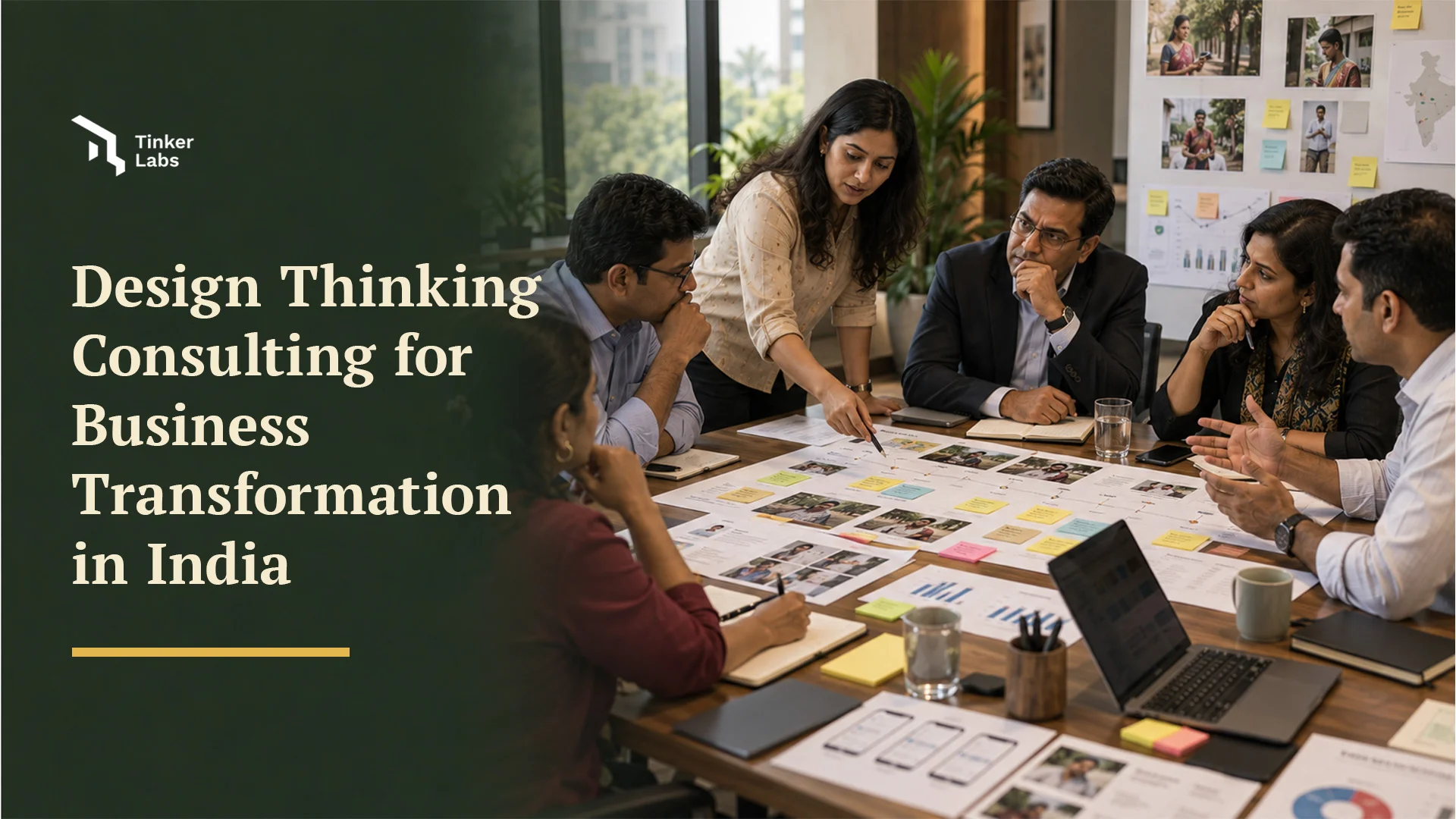
Implementing a company's strategy through workshops is a core service TinkerLabs offers. These large-scale sessions typically bring together teams from product, operations, technology, and service. A well-run enterprise workshop should produce:
- A current-state map that highlights friction points
- Clearly named opportunity areas
- Key service principles for the team to design against
- Early prototypes of potential solutions
- A prioritised list of ideas
- A named list of stakeholders required for the next steps
Some engagements follow a fixed evidence-to-synthesis-to-action sequence inlcuding problem statement, opportunity areas, test concepts, implement while others prioritise pace over that structure.
Where the goal is lasting capability rather than a single outcome, many Indian enterprises now pair these sessions with structured design thinking workshops delivered as part of a wider training track, so internal teams can run similar sessions independently over time.
3) Prototype Before You Invest Heavily
Prototyping is one of design thinking's biggest strengths in a consulting context. Large organisations often spend months planning a new process or service before testing it; design thinking pushes teams to prototype early and cheaply, before serious time and money is committed.
A prototype doesn't need to be polished; it needs to be good enough to test. In practice, this can look like:
- Process sketches, mock-ups, or a simple landing page
- A service script read out during a role-play
- Customer journey storyboards
- Employees role-playing a service to surface problems before launch
The only requirement is that a prototype reveals real problems before a full launch not that it looks finished.
4) Measure, Refine, And Scale
A serious design thinking engagement doesn't end when the workshops do. It ends once the organisation has worked through the change and proven the concept such as higher adoption, a leaner process, better conversion through a new service, or whatever outcome mattered for that engagement. The specific measures depend on the organisation's own goals, but they should be agreed upfront, not decided after the fact.
Building capability, not just a moment: the most durable engagements don't leave when the consultants do, the methodology stays behind. That typically means:
- Naming internal “design champions” across functions who can facilitate future sessions
- Setting up a small centre of excellence with the tools needed for ongoing prototyping
- Tying at least one leadership KPI to a design metric, ideas prototyped and tested with real customers, not just workshops run
Where Design Thinking Creates Measurable Business Transformation
Design thinking earns its place in a consulting engagement when it changes how a company actually makes decisions, not just how it brainstorms. That shows up in four areas:
- Customer experience: teams redesign journeys around real needs, not internal org charts.
- Operational efficiency: removing unnecessary steps, duplicated work, and handoffs.
- Innovation pipelines: moving from brainstormed ideas to fast validation with customers and stakeholders.
- Organisational alignment: helping teams prioritise and trade off competing goals using a human-centred approach.
For leadership, the value is simple: better decisions, with fewer wrong assumptions. That's why so many transformation programmes now run design thinking alongside, not instead of, their existing change methodology.
What A Strong Consulting Engagement Looks Like
A credible design thinking consulting engagement follows a specific sequence:
- Diagnostic: set the business context, clarify stakeholder priorities, identify customer segments, and pinpoint pain points.
- Research: qualitative and quantitative work to define the problem and the potential solution space.
- Workshops: focused sessions to define problems, align teams, and generate solution directions from the research.
- Prototype: build a low-fidelity version of the concept that can be tested with real users, staff, or operational stakeholders.
- Validation: test findings with end users and key operational stakeholders before committing further.
- Implementation support: hand the results to internal owners, with a clear plan and measurable outcomes.
This sequence works because it keeps the engagement grounded in business reality. A consultant's job is to help an organisation decide and to build the internal confidence to carry that decision through.
The Role Of Strategy Facilitation
Strategy facilitation matters because business leaders often only get as far as discussing ideas but the decisions still need to be made, and implemented, by cross-functional teams who may see the problem very differently. Effective facilitation sets the 'rules of engagement,' makes trade-offs visible, keeps the discussion evidence-based, and creates a psychologically safe environment where people can challenge each other's assumptions without the conversation turning into office politics.
This is also where good behavioural science consulting earns its keep. Indian enterprise hierarchies often default to what's known as the “HiPPO” effect meaning the Highest Paid Person's Opinion quietly overriding the room. This HiPPO decision bias shows up in innovation planning as often as it does in day-to-day strategy, which is exactly where structured facilitation earns its value. Structured facilitation counters this directly: anonymous ideation, silent brainstorming, and mixed-seniority working sessions give junior engineers and frontline staff the same voice as the executives in the room, and reframe failure as data rather than something to be punished. Pairing design thinking with behavioural science consulting helps leadership teams notice these biases in the moment, not just in a retrospective.
Good strategy facilitation leaves an organisation with clearer priorities, a shorter list of things to work on, and a workable way forward.
Why The “How Might We” Mindset Still Matters
Using the language of design thinking is critical for engaging stakeholders and turning observed problems into solutions. “How Might We” (HMW) questions reframe a problem as a challenge to be investigated and validated within real constraints rather than a complaint to be solved by the loudest voice in the room.
This framing keeps the team focused on high-value solutions, and makes sure the ideas generated can actually be built for end users.
Common Mistakes Organisations Make
The same mistakes show up across most failed design thinking initiatives:
- Starting with a solution and looking for the problem afterwards
- Treating a workshop as the end of the change process, not the start
- Ignoring frontline staff, who understand friction better than anyone
- Measuring activity instead of adoption, retention, or operational improvement
- Skipping prototyping and moving straight into costly execution
Discipline fixes most of this: the right scope, adequate research, a properly structured workshop, and a test-and-learn approach to implementing change.
Design Thinking Consulting In India — Choosing The Right Partner
Demand for design thinking workshops India-wide has grown sharply as more leadership teams treat innovation as a core capability rather than a one-off event. Use this checklist when evaluating a design thinking consulting partner in India:
- Can they explain how they frame problems before proposing solutions?
- Do they have real evidence of applying human-centred design across different business contexts?
- Can they facilitate large workshops and turn them into decisions stakeholders actually commit to?
- What problem does their approach solve for your organisation, specifically?
- What change outcomes will be measured, and how?
- Will they support implementation, not just ideation?
Innovation work is where consultants can make good money selling 'design thinking as a capability' which makes it worth drawing a clear line between genuine innovation work and standard business consulting repackaged with sticky notes. The right partner is comfortable with ambiguity without being vague: they bring structure to problem-solving, keep a record of decisions made, and follow through on what they promise.
Conclusion
Design thinking helps Indian teams define the right problems and act on the insights that follow and it works best when it's structured and measurable, not just inspirational. Combined with human-centred design, disciplined strategy facilitation, sharp problem framing, and a structured set of enterprise workshops, design thinking consulting becomes a real business capability not just a source of ideas that never leave the workshop room.
References
- Ergonomics of human-system interaction: Human-centred design for interactive systems (Accessed Sept 2026). Available from: https://www.iso.org/standard/77520.html.
- Stanford d.school. An Introduction to Design Thinking Process Guide (Accessed Sept 2026). Available from: https://web.stanford.edu/~mshanks/MichaelShanks/files/509554.pdf.
- IBM Training. Enterprise Design Thinking (Accessed Sept 2026). Available from: https://www.ibm.com/training/enterprise-design-thinking.
- Nielsen Norman Group. Design Thinking 101 (Accessed Sept 2026). Available from: https://www.nngroup.com/articles/design-thinking/.
- Nielsen Norman Group. Using "How Might We" Questions to Ideate on the Right Problems (Accessed Sept 2026). Available from: https://www.nngroup.com/articles/how-might-we-questions/.
- Enterprise Design Thinking Framework (Accessed Sept 2026). Available from: https://www.ibm.com/training/enterprise-design-thinking/framework.
Start The Conversation
TinkerLabs supports leadership teams from across India with design thinking consulting and strategy facilitation to help turn ambiguity into change outcomes. We have a slew of projects on the go, and would love to speak with you and your team about how we might be able to support your transformation goals. Contact us here.
About the Author

Mandeep Toor
Head of Trainings & Workshops at TinkerLabs
Mandeep helps organisations build innovation capability through design thinking and behavioural science. With over a decade in innovation and entrepreneurship, he has led 75+ workshops for leaders at firms like Piramal Group, Samsung, Flipkart, HP, and Hindustan Unilever, and teaches Design Thinking at IIMs, MICA, and SOIL Institute of Management. Know more →

