


Design Thinking Vs Service Design Vs Design Sprint: Which Framework Does Your Team Actually Need?


Short Description
Design Thinking, Service Design, and Design Sprints keep getting used as if they mean the same thing, and that confusion is exactly what leads teams to commission the wrong kind of work. This guide separates the three by scope and speed, showing why Design Thinking works best as an ongoing mindset for problems nobody has fully named yet, Service Design fits when the issue spans multiple touchpoints and departments, and a Design Sprint is the right call only when a specific idea just needs fast validation. Along the way it touches on applying design thinking for business innovation as the broader philosophy tying all three together. It closes with a practical way to decide which one your team actually needs, rather than which one happens to be trending.
Blog Summary
Design thinking vs service design vs design sprint is a comparison that comes up constantly, but the three are often used interchangeably even though they solve different problems at different scales. If you're weighing a hands-on design thinking workshop for your team against a longer engagement, understanding the difference matters before you commit to either. Design Thinking is a broad, ongoing design thinking mindset for tackling ill-defined human problems.
The Service Design framework is that same thinking approach applied to designing a service journey end-to-end in a multi-channel system. The Design Sprint framework is a time-bound process used for validation of a specific idea in just 4 to 5 days. This document will detail what each design thinking framework accomplishes and how they differ from one another in terms of application and outputs. It will also help determine when to use each framework.
Introduction: Why These Three Terms Get Confused
Ask five people to define "Design Thinking," "Service Design," and "Design Sprint," and you'll likely get five different, overlapping answers. That's not because the concepts are vague, it's because they operate at different scales and get used loosely in casual conversation, workshops, and job descriptions alike.
This creates real confusion for teams trying to decide what to actually do. A product team might be told to "run a design sprint" when what they need is months of service design work. A leadership team might commission a "design thinking workshop" expecting a finished prototype in two days, which isn't what Design Thinking, as a broad problem-solving mindset, is built to deliver.
Getting this right matters because each framework has a different time commitment, a different output, and solves a different kind of problem. Here's how to tell them apart, and how they actually work together.
What Is Design Thinking?
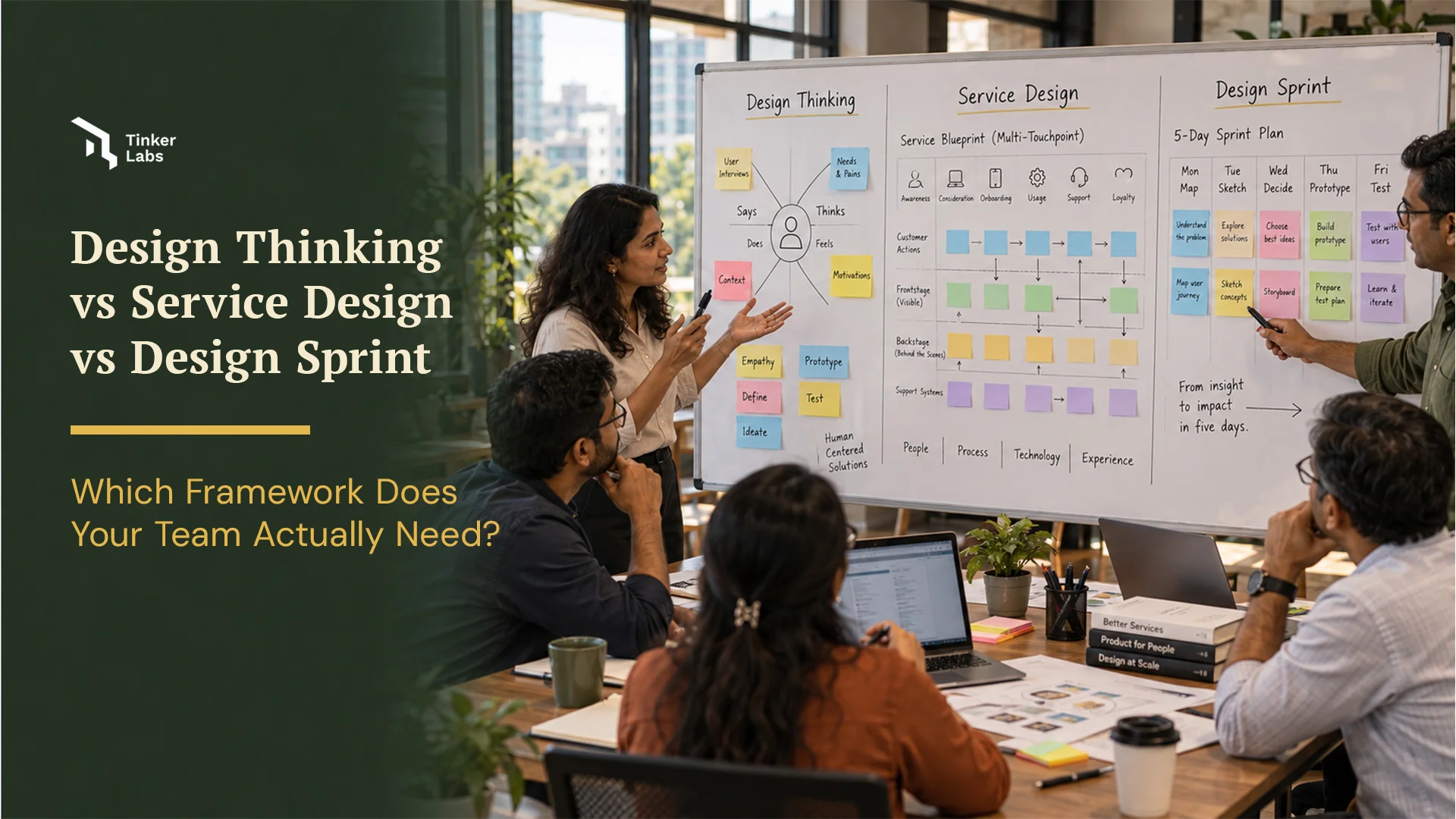
Design Thinking is a broad, non-linear philosophy for tackling ambiguous, human-centered problems, the kind where you don't yet know what the right solution looks like, or sometimes even what the real problem is. It typically moves through five iterative design thinking stages, Empathize Define Ideate Prototype Test, though teams often loop back and forth between them rather than moving in a straight line.
Design Thinking doesn't have a fixed timeline. It can run for weeks or months, depending on the complexity of the problem. Its output isn't a single deliverable, it's a body of user insight, a validated problem definition, and typically several tested concepts rather than one finished solution. This is the core of the design thinking mindset: staying with the problem long enough to be sure it's the right one before committing to a solution.
What Is Service Design?
Service Design takes this human-centered approach to the design of something bigger than a single product or feature: an end-to-end service experience that often includes digital interfaces, physical spaces, staff interactions, and back-end operations.
Its signature tool is the service blueprint, a map that lays out every touchpoint a customer experiences alongside the internal processes and systems that support it, over time. This is what makes Service Design highly relevant in the context of the end-to-end customer journey design process, since the real challenge is not fixing a particular broken touchpoint, but aligning departments and channels within the broader customer journey context. Like Design Thinking, it tends to be continuous or project-based rather than tightly time-boxed. Weighing service design vs design thinking often comes down to exactly this: whether the problem lives in one interaction or spans the whole journey.
What Is A Design Sprint?
A Design Sprint is the most structured and time-constrained of the three, and one of the more widely adopted user-centered design frameworks in product teams today. Pioneered by Google Ventures design sprint methodology, it compresses core Design Thinking activities, understanding the problem, generating ideas, building a prototype, and testing it with real users, into a strict 4-to-5-day process with a defined agenda for each day.
Where Design Thinking and Service Design are open-ended, a Design Sprint is deliberately a recipe: a specific design sprint process that takes a team from a defined business problem to a tested, interactive prototype in one week through rapid prototyping sprint work. It's built for speed and focus, not for exploring open-ended or poorly understood problems, that's what Design Thinking is for. This is the crux of design thinking vs design sprint: one explores, the other validates.
Key Differences At A Glance
These aren't competing options, each is suited to a different scope and speed of decision.
How The Three Frameworks Work Together
The clearest way to see how these three relate is to think of Design Thinking as the underlying operating system, the user-first mindset that shapes how your team approaches any problem. Service Design applies that operating system at the scale of a full, multi-channel service, mapping how technology, people, and processes come together across an entire journey. A Design Sprint, by contrast, is a specific app running on that operating system, a fast, focused tool you reach for when you need to validate one clearly defined idea quickly, without committing to a multi-month initiative.
In practice, mature organizations don't pick one and abandon the others. They use Design Thinking as an ongoing mindset, Service Design when the problem spans a full journey, and Design Sprints when a specific bottleneck needs a fast, testable answer.
Which One Should You Use First?
If you're not sure where to start, the scope of your problem is the best guide.
If the problem is broad and not yet well understood, you sense something is wrong but can't yet name it precisely, start with Design Thinking. This is also where a hands-on design thinking workshop for your team is most valuable: it builds the shared mindset and vocabulary your team will use in every framework that follows.
If the problem clearly spans multiple touchpoints, departments, or channels, a customer complains about "the whole experience," not one screen, Service Design is the right scope. This kind of end-to-end work is often where organizations bring in a behaviour design consultancy, since mapping and redesigning a full service typically needs dedicated facilitation and cross-functional coordination.
If you already have a specific, well-defined problem and need a tested answer fast, run a Design Sprint.
Many organizations use all three by applying design thinking for business innovation as the underlying philosophy across their broader innovation and transformation programs.
Conclusion
Design Thinking, Service Design, and Design Sprints aren't competing methodologies, they're tools built for different scopes and speeds. Design Thinking is the mindset. Service Design is that mindset applied to a full journey. A Design Sprint is a fast, focused shortcut for testing one idea.
The mistake most teams make isn't choosing the "wrong" framework, it's expecting one framework to do a job it wasn't built for, like expecting a five-day sprint to redesign an entire service, or a broad Design Thinking initiative to move at sprint speed. Matching the framework to the actual scope of the problem is what makes any of them work.
Frequently Asked Questions
1. What Are The 5 Stages Of Design Thinking?
Design Thinking typically moves through five stages, Empathize Define Ideate Prototype Test. Teams rarely move through them in a strict straight line; looping back to earlier stages as new insights emerge is normal and expected.
2. Is Design Thinking The Same As Agile?
No, however, on the other hand, similarities exist in both of them. They both are iterative and user-centered processes; however, in design thinking vs agile, the difference is in their application: Design Thinking focuses on finding and understanding a problem which needs to be solved, whereas Agile is a process used to provide a solution to the problem that is known.
3. Is Design Thinking Still Relevant In 2026?
Yes, as artificial intelligence tools take care of executing tasks that have become repetitive and boring, the skill to formulate a problem properly becomes all the more important, which is precisely the role played by Design Thinking.
4. How Do You Decide Between A Design Sprint And A Longer Design Thinking Engagement?
Use a Design Sprint when you already have a specific, well-defined problem and need a tested prototype within a week. Engage in an extended process of Design Thinking when the problem at hand isn’t even defined or when there is a need for deep user research before being able to identify the problem.
Not Sure Which Framework Fits Your Problem?
TinkerLabs works with teams across India on all three, running a hands-on design thinking workshop for your team when the problem needs framing, a full behaviour design consultancy engagement when it spans an entire customer journey, and fast, focused sprints when you already know what needs testing. Tell us where you're stuck, and we'll help you figure out the right way in. Contact Us.
About the Author

Mandeep Toor
Head of Trainings & Workshops at TinkerLabs
Mandeep helps organisations build innovation capability through design thinking and behavioural science. With over a decade in innovation and entrepreneurship, he has led 75+ workshops for leaders at firms like Piramal Group, Samsung, Flipkart, HP, and Hindustan Unilever, and teaches Design Thinking at IIMs, MICA, and SOIL Institute of Management. Know more →

